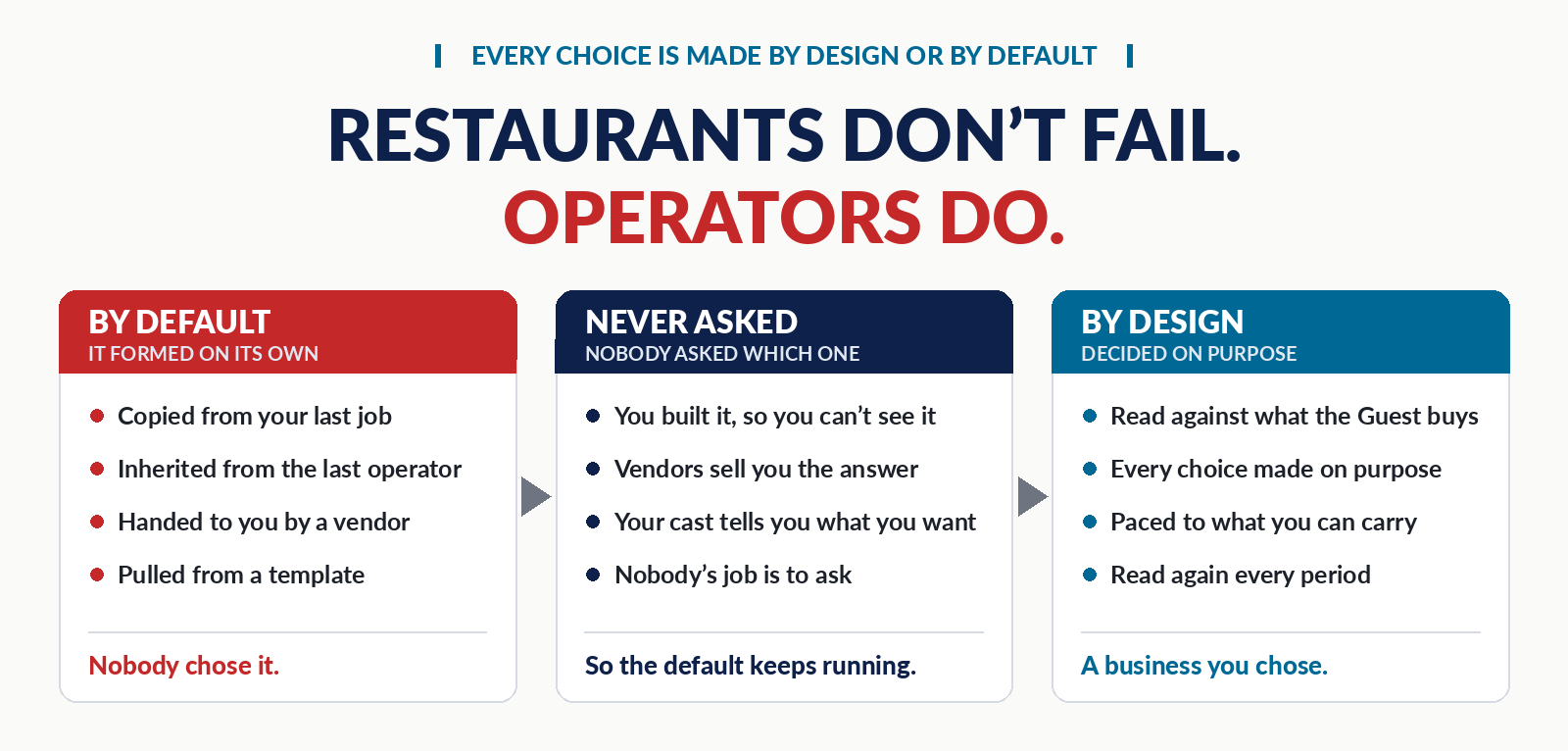
Restaurants don’t fail. Operators do.
When a restaurant closes, the restaurant gets the obituary. The sign comes down, the lease goes back, and everybody says the market turned, the rent went up, the labor dried up. But a restaurant doesn’t make decisions. You do. Every number on your P&L, every Guest who doesn’t come back, every cast member who walks out mid-shift traces back to a decision somebody made, or never made.
That isn’t an accusation. It’s the most useful thing anybody can tell you, because if you’re the cause, you’re also the fix.
Design Or Default
Every choice you make is made by design or by default. There is no third option.
The menu you’re running. The schedule. The prices. The way your cast greets a Guest at the door. Either somebody sat down and decided it on purpose, against what your Guest is actually buying, or it formed on its own: copied from the last place you worked, inherited from whoever ran the building before you, handed to you by a vendor, a franchisor or a template you found online.
Most of what’s running in most restaurants is default. Nobody chose it. It just stayed.
Did You Design This, Or Did It Just Happen?
Nobody Asked
Here’s the hard part. You can’t see your own defaults. You built the thing, you’re in it every day, and that’s exactly why you can’t see it. The operator who built the operation is the last person who can see it clearly.
So when was the last time somebody sat across from you and asked whether what you’re running is by design or by default? Not a vendor selling you the answer. Not a cast member telling you what you want to hear. Somebody whose job was to ask.
For most operators the answer is never. They never asked for help, and nobody asked them the question.
Who Asks You The Hard Questions?
Reading Your Business
Ask an operator what’s hurting his business and he’ll tell you: labor, food cost, rent, delivery fees, the economy. Those are the numbers. They aren’t the cause. The cause is upstream, in a decision the numbers are reporting back to you.
Reading your business means tracing the number back to the decision that produced it. Until you can do that, every fix you buy is aimed at a symptom.
Are You Killing Your Business?
Growing
There are two questions every restaurant has to answer: are you growing, and is it the right growth?
Some operators aren’t growing at all. They’re holding last year and calling it stable. Others are growing wrong: sales bought with a discount, a change faster than the business can carry, a location the lease chose for them. Both pay the same tax, the growth they could have had and didn’t.
Growth isn’t more sales. It’s capability: what your business can do this period that it couldn’t do last period. And nobody ever taught you how to build it.
Are You Growing, And Is It The Right Growth?
What You Offer
Your Guest comes for the Product. Not your sign, not your social media, not your loyalty app. The Product: what he’s paying for when he walks in, from what’s on the plate to the experience around it.
So the question isn’t whether your Product is good. Plenty of restaurants are good. The question is whether it’s different in a way he values enough to choose you over the place next door and pay for it. If it isn’t, you’re competing on price, and somebody can always beat you on price.
Why Does Anyone Care About What You Offer?
Your Cast
Your cast delivers your Product to your Guest every shift. And every operator has the line ready: nobody wants to work anymore.
The operator down the street hires from the same pool, at the same wage, in the same week. Some of them keep their cast for years. Some replace theirs entirely inside twelve months. It isn’t that nobody wants to work anymore. It’s that nobody wants to work for you. People leave when they stop growing, and an operation that never designed a way for them to grow will keep losing them.
Getting Help
Which brings it back to the question nobody asked you.
Most of the help sold to operators makes it worse. A system installed on top of a thinking problem. A checklist built to generate a lead. A consultant who comes back every quarter to the same problem, because it was never solved.
Real help reads your business with you, builds a capability you own, and stays with it until it’s ingrained. Then it moves to the next one. Before you sign anything, ask whoever you’re considering one question: what will I be able to run without you that I can’t run today?
