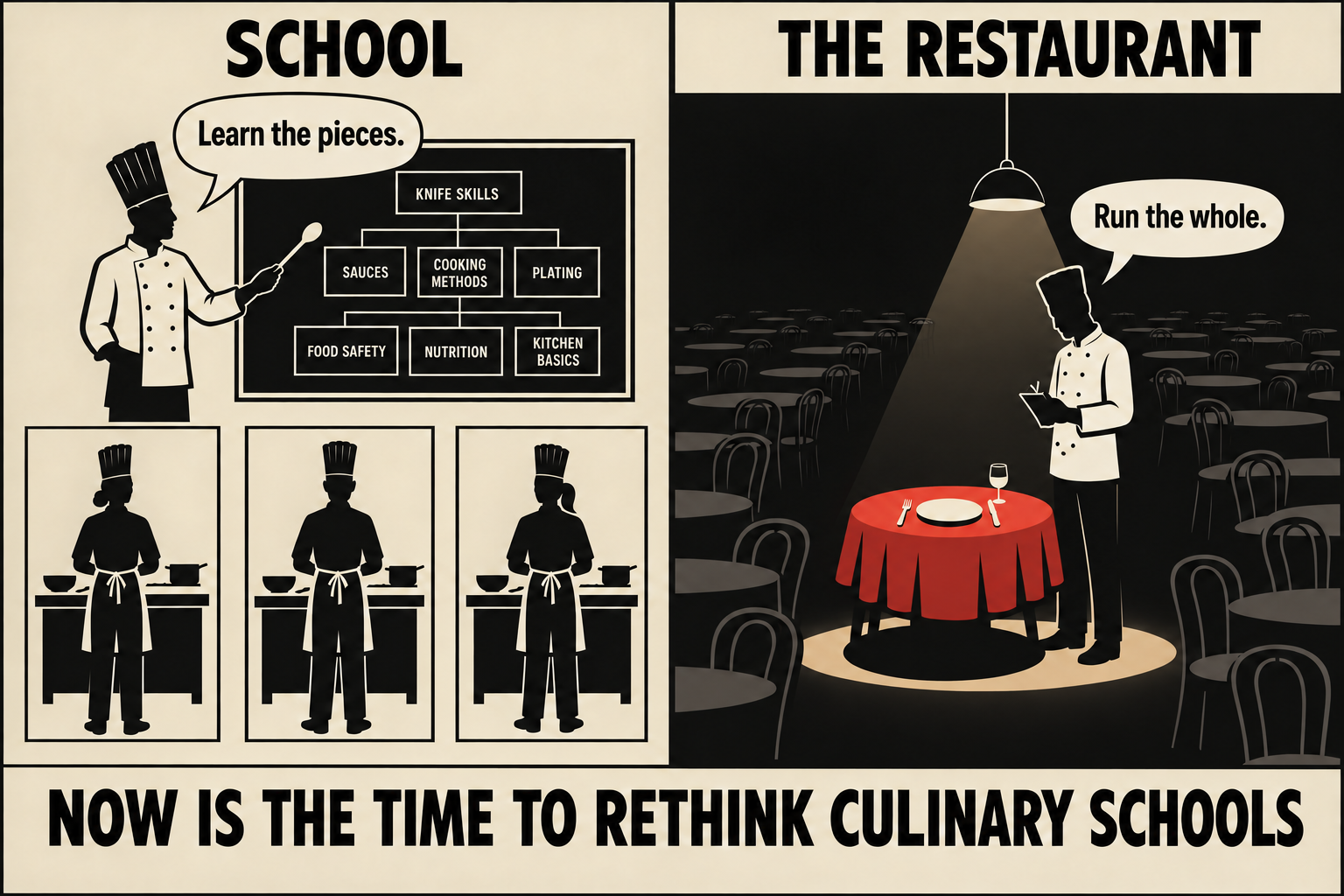
Every operator I talk to has the line ready before I finish the question. Nobody wants to work anymore. The labor pool is thin. This generation will not be held accountable. The wage down the street is a dollar higher and there is nothing I can do about it.
The labor market in your trade area is identical for every operator on your block. Same pool, same wage band, same generation, same week, same rent, same weather. Some of those operators keep their cast for years. Some replace theirs entirely inside twelve months. A condition held constant across every operation cannot explain a difference in outcomes between them. That is not an opinion about labor. It is what a constant is.
So the sentence has to change, and the change is not cosmetic. It is not that nobody wants to work anymore. It is that nobody wants to work for you.
I have spent forty-five years in this business, and I have watched that one sentence get swapped for the other in a single conversation and change what an operator does for the next three years. This is the whole issue, taken apart: why people actually leave, why the folklore is so durable, what the numbers say when you stop reading them as weather, the mechanism producing all of it, and what I do with it when I sit down with an operator.
Why Restaurant Employees Quit
They leave for one reason, expressed eleven different ways. No growth.
Financial growth stopped. Skill growth stopped. Intellectual growth stopped. Relational growth stopped. Structural growth — the plain ability to see a next step and believe it exists — stopped. Strip the labels off every exit interview you have ever read and the same shape sits underneath all of them. Someone stopped moving forward and correctly concluded that staying was not building anything.
Nobody took a job to stand still.
Every reason your departing cast member gave you is a description of what the environment felt like, not an explanation of why they left. Bad culture. Poor leadership. Didn’t feel valued. Difficult Guests. Broken processes. No work-life balance. Every one of those is real and every one of those is a symptom. They tell you what the room was like. They do not tell you why the person walked out of it.
Because people stay in difficult rooms for years when the room is building them something. They leave comfortable rooms in six months when it isn’t. That asymmetry is the tell, and once you see it you cannot go back to reading exit interviews as causes.
The cast member who left for a dollar more did not leave for the dollar. The dollar was the first tangible offer of something better to arrive after the growth they expected had already stopped. If growth had been live, a dollar would have been a conversation. Instead it was a door.
The one who left over a difficult lead did not leave over the lead. They left because nobody was developing them through that difficulty. Friction with nothing on the other side of it is just friction. Friction inside a development arc is training, and people will absorb a remarkable amount of it when they can see what it is making them into.
The one who left because they “didn’t feel valued” is the most misread of all. Value is not a feeling you install with recognition. Being invested in is what feeling valued is made of. You cannot praise someone into feeling valuable while their capability sits exactly where it sat a year ago. They can tell.
The Departure Happens Before The Resignation
By the time someone gives notice, they left months earlier. The resignation is the paperwork.
The actual departure is a quiet, dateable moment: the day they stopped believing the next step existed. After that, everything you observe is a person managing an exit they have already decided on. The dip in discretionary effort. The withdrawal from the parts of the job that were never in the job description. The sudden reasonableness about problems they used to fight about. Operators read that stretch as attitude. It is grief for a future that got cancelled.
This matters operationally for one reason. Every retention move you make after that moment is aimed at someone who is already gone. That is why the counteroffer fails, why the raise buys ninety days, why the promotion arrives as an insult rather than an opportunity. You are negotiating with someone about a future they stopped believing in before you noticed anything was wrong.
The only work that lands is upstream of that moment. Which means the only useful question is not why people leave. It is what your operation does to intent while it is still intact.
Why The Folklore Survives
The conventional wisdom treats turnover as weather — something that happens to a restaurant rather than something a restaurant produces. That framing has survived decades of contradicting evidence, and it deserves an honest explanation rather than a scold.
It survives because it is exculpatory. If cast members leave because of a labor market the operator does not control, then the operator’s leadership never enters the conversation. Not as a factor to weigh, not as a variable to test. It is structurally excluded. Every other diagnosis in this business puts something of the operator’s on the table. This one is the only one that puts nothing there, which is exactly why it is the most repeated sentence in the industry.
It survives because it is socially confirmed. The operator says it at the association meeting and eleven other operators nod. That nod feels like evidence. It is not evidence. It is eleven people running the same architecture reporting the same output, which is what you would expect if the architecture, not the market, were producing the result.
And it survives because it is partly true at the surface, which is the most dangerous kind of wrong. Labor markets are real. Wage pressure is real. Demographics are real. None of that is in dispute. The error is not in noticing the weather. The error is in promoting weather to cause, in a comparison where the weather is identical for everyone being compared.
I am hard on this because the sentence is not harmless. It is expensive. An operator who believes it spends his money on recruiting, his attention on wage benchmarking, and his hope on a market shift, for years, while the actual mechanism runs untouched in his own building.
That Is Not Semantics, It Is A Different Room
The first defense against all of this is that it is a word game. Turnover is turnover. The position is empty either way.
But the two framings send you to two different rooms to do the work, and only one of those rooms contains anything you can move.
If they left because of the market, the work is recruiting, wage benchmarking, referral bonuses, faster onboarding, and waiting. All of that sits outside your building. None of it is yours. Your best possible outcome is to replace people slightly more efficiently than the operator across the street, forever.
If they left because growth stopped, the work is what you built, what you funded, what you scheduled, what you noticed, and what you never taught. All of that sits inside your building. Every bit of it is yours. Your best possible outcome is an operation people do not want to leave.
Same empty position. Two diagnoses. One of them is a permanent expense and the other is a design problem with a solution. That is not semantics. That is the difference between a cost you carry for the life of the business and a decision you get to make.
What The Numbers Say When You Stop Reading Them As Weather
The industry research is not ambiguous, and it does not support the folklore. It contradicts it in a specific and useful way.
Roughly two-thirds of restaurant cast members have quit a restaurant job. About a fifth have done it more than once. Average tenure in the industry sits near a hundred and ten days. Full-service turnover runs close to a hundred percent annually in a normal year.
Read those as weather and you get resignation. Read them as output and you get a different picture immediately, because the same research reports that leads and managers turn over at nearly thirty percent themselves. The failure is compounding upward before it compounds downward. The people you would need in order to develop anyone are also leaving, which means the development capacity of the operation is being drained from both directions at once. That is not a labor pool problem. A labor pool does not selectively remove your developers.
Then look at what departing cast members name as their reasons. Pay and difficult leads come in tied at the top. Below that, in a tight cluster: not enough shifts, lack of growth opportunities, schedule instability, lack of recognition and feedback.
Sit with that list for a second. Aside from the first item, not one of those requires a wage increase to fix. Not enough shifts is a scheduling and staffing-model decision. Growth opportunity is a development-architecture decision. Schedule instability is an admin decision. Recognition and feedback is a leadership-practice decision. Four of the top drivers of your turnover are decisions you already own and are already making — you are simply making them by default rather than by design.
And the item that does look like money mostly isn’t. Pay is where a growth complaint goes to be socially acceptable. “I need more money” is a sentence you can say to your boss without insulting him. “I have stopped becoming anything here” is not. Pay is the polite proxy, which is why raises buy time rather than loyalty, and why the operator who reads the proxy literally keeps buying ninety-day extensions at increasing prices.
There is one more number worth naming, because it is the one that predicts the future rather than describing the past. Three-quarters of cast members say a clear career path matters to them, and only about half believe their goals can actually be met where they currently work. That second figure has been sliding. The gap between those two numbers is your future turnover, already committed, sitting on your current schedule. Those people have not resigned. In the way that matters, most of them are already gone.
The Commitment Already Walked In
The strongest objection to everything above is that restaurant work is inherently transient. That the growth framing is wishful thinking applied to a job nobody intended to keep. Students, second incomes, people passing through on the way to something else. You cannot develop a workforce that never planned to stay.
The research answers that one directly, and the answer strengthens the case rather than softening it.
Somewhere near a quarter of restaurant cast members describe themselves as lifers. About forty percent report long-term intent to stay in this industry. Those are not people drifting through. They arrived already carrying the intent to build a life in this business, which is the single hardest thing to manufacture and the one thing you did not have to.
You cannot blame the raw material when that much of the raw material tells you upfront that it came to stay.
Which relocates the entire problem. If the intent shows up at the back door and is gone by the hundred-and-tenth day, the question is not whether people want to work. The question is what your operation does to intent that already arrived. And the answer, in most operations, is nothing. Nothing is done to it. Nothing is done with it. It is not asked about at hire, not named in a review, not attached to a schedule, not funded, not tracked, and not noticed when it dies.
Intent does not need to be crushed to die. It needs only to be unused. Nobody has to do anything wrong. Default is sufficient.
That is why I do not start an engagement on the hiring side, and I will push back hard when an operator wants to. Hiring is where operators want to start because hiring feels like action and requires no examination. But an operation that extinguishes intent will extinguish the intent of better candidates just as reliably. Fix the machine before you feed it better material, or you will simply waste better material at a higher cost per unit.
You Cannot Build Growth You Cannot Define
Here is where this stops being a People problem and becomes the same problem I write about everywhere else in this business.
Most operators were taught that growth means more. More covers, more sales, more check average, more locations, more output per labor hour. That is accumulation. Accumulation is not growth. Growth is an increase in what an operation is capable of creating. The two get the same name in this industry, and the confusion is the first cause underneath most restaurant failure, not just most restaurant turnover.
Now run that false definition into the cast side and watch what happens. An operator who defines growth as more cannot build growth for a cast member, because he does not have a working definition of the thing he is being asked to build. What he has instead is a set of substitutes, and he will offer them in good faith:
More hours. More money. More responsibility, which in practice means more of the same work with the same capability. More title, with the same authority. A promotion into a role nobody prepared him for and nobody will prepare her for either.
Every one of those is more. Not one of them is growth. And the cast member can feel the difference inside a month even when she cannot name it, because the test is simple and involuntary: am I becoming more capable, or just more loaded? Loading is not development. Loading is what development looks like to an operator who has never separated the two.
This is why the operator who says “I gave her everything and she left anyway” is usually telling the truth about what he gave. He gave more. She needed to become something. Those are not the same transaction and no amount of the first one adds up to the second.
So the first question I ask in an engagement, before I look at a schedule, a wage scale, an org chart, or a turnover report, is what the operator thinks growth is. Not as a philosophical warm-up. The answer to that question predicts nearly everything downstream of it — how he reads his P&L, how he prices, whether he wants a second location, and whether anyone on his current schedule is going to be there in a year. It is one question and it is diagnostic on all five fundamentals at once.
The Five Places The Growth Was Supposed To Come From
If growth is capability rather than accumulation, then it has specific channels, and each one fails in a way you can see from inside the building.
Financial. Not a raise. A visible, earned relationship between what someone becomes capable of and what they make. Most operations have no such relationship — pay tracks tenure and negotiation rather than capability, which teaches the cast that becoming better at this is financially irrelevant. They learn that lesson quickly and they are not wrong to learn it.
Skill. The actual, nameable expansion of what a person can do. Not cross-training for coverage, which is the operation solving its own scheduling problem and calling it development. Skill growth is training that leaves the cast member more valuable everywhere, including somewhere else. Operators flinch at that. The flinch is the reason their people leave.
Intellectual. Understanding the business they work in. Why the mix matters, why the prep list is ordered the way it is, what the number on the wall actually measures, what decision their station is downstream of. Cast members handed context stop executing tasks and start making decisions. Cast members starved of it stay task-executors permanently, which is boring, and boredom in a capable person is a countdown.
Relational. Being known. Not liked, not appreciated — known. Somebody senior who knows what this person is working toward, remembers it a month later, and asks about it. This is the cheapest channel in the entire list and the most reliably absent, because it takes attention rather than money and attention is the one thing an operator running default admin has already spent.
Structural. Being able to see the next step and believe the path to it exists. Not a promise of promotion. A visible architecture: what the next role is, what it requires, who decides, on what timeline, and what happens if you meet the requirement. Absent that, ambition has nowhere to go, and ambition with nowhere to go looks exactly like a job search.
Every exit interview reason you have ever collected maps onto one of those five. Which means every exit interview you have ever read was a report on which channel was closed, misfiled as a report on the person who noticed.
You Do Not Retain Good People, You Deserve Them
Retention is the wrong instrument. That is why every instrument sold under that name underdelivers, and why the operators who buy the most of them are frequently the ones with the worst numbers.
Retention problems get solved with retention tactics. Signing bonuses. Referral bonuses. Contests. Stay interviews. Recognition programs. Engagement platforms and pulse surveys. Better scheduling apps. Pizza parties, which I will not pretend anyone believes in but which persist anyway.
Growth problems have exactly one solution: actually developing the people you are asking to stay.
Run a retention tactic against a growth problem and the arithmetic is predictable. You get a short lift, a new permanent line item, and the same cast member gone on roughly the original timeline. Worse, you have now taught the operation that the problem was addressed, which buys the real mechanism another year of running unexamined. A tactic that produces the feeling of action against the wrong cause is more expensive than doing nothing, because doing nothing at least leaves the question open.
The contest deserves its own line, because it is the purest specimen. A contest pays for a burst of behavior you were unwilling to build the conditions for. It works exactly as long as the prize lasts, it teaches the cast that this behavior is extra rather than expected, and it reliably rewards the person who was already strongest, which your best people already knew and your weakest people just confirmed.
So I will not sell you a retention program, and I will push back when you ask me for one. My own industry sells that category hard, and it sells well for a precise reason: it lets an operator address turnover without examining the environment that produces it. It is the same trade as the discount. The operator who discounts cannot see how to create value a Guest will pay full price for. The operator who cannot keep cast cannot see how to create an environment the cast will stay in at the current wage. Both are failures of Perspective. Both are paid substitutes for something that had to be earned.
You do not retain good people. You deserve them. And if that sentence lands as harsh, notice that it is also the most hopeful thing in this piece, because deserving them is a thing you can go do.
Read The Reward Structure Before The Culture
Operators who have done real work on this still lose it in one place. They install relational intent — a Guest-first read, a development posture, a values statement everyone can recite — and they hang all of it on a reward structure that pays for throughput.
Look at what yours actually pays for. Not what it says. What it pays.
In most operations, the best and the worst cast members earn close to the same, which means your best are subsidizing your worst. They do that math. They do it early, they do it without being asked, and they are more accurate about it than you are.
Development is unfunded and unscheduled, which means coaching loses to coverage every single time it competes. Not because anyone chose coverage over coaching, but because coverage has a time on it and coaching does not, and the thing with a time on it always wins.
The fastest route to advancement is usually to be the person who does not create problems rather than the person who creates capability. So the operation systematically promotes smoothness and systematically fails to promote the people who were building something, who then leave and take the capability with them.
And the loudest number in the building is the one on the wall at the end of the shift. Whatever that number is, that is your actual values statement. Everything else is signage.
An operation like that is not partially designed. It is incoherent, and incoherence does not hold as a stable mixed system. Under pressure it collapses toward whichever layer runs in the cheapest and most default form, because default is always cheaper than design. That means the reward structure wins and the relational intent loses, every time, and the operator experiences the collapse as a people problem rather than as the structural outcome it is.
Which is why I read the reward structure before I read the culture. Culture is a downstream reading of what the structure pays for. When the two disagree, the structure is telling you the truth.
You Cannot Motivate Anyone
The other place operators reach for is motivation. Get them fired up. Bring in a speaker. Change the pre-shift.
You cannot motivate anyone. You can only create the conditions in which their motivation finds something worth investing in.
That is not a soft distinction, it is an operating one. Motivation is not a resource you inject; it is a resource that arrives with the person and then looks for somewhere to go. Your cast walked in with it. What your operation determines is whether it finds a target or dies of exposure. Everyone you have ever described as unmotivated is a person whose motivation surveyed your operation and found nothing worth aiming at.
Two mechanisms follow from that, and both are nearly free.
The first is ownership. Owning an idea is infinitely more powerful than having one stuffed down your throat. The prep change the kitchen manager designed gets defended; the identical change handed down gets complied with until nobody is watching. Operators who cannot understand why their obviously correct systems keep decaying are almost always looking at systems nobody on the stage had any hand in building.
The second is the conversation nobody schedules. Around seventy percent of restaurant cast say they prefer in-person conversation, and about two-thirds say more one-on-ones would change how they feel about their job. One-on-ones are rarer in restaurants than in nearly any corporate environment, which is not a resource problem. A restaurant lead is physically closer to more of his people for more hours a day than any corporate manager alive. The proximity is already paid for. What is missing is the practice of turning ten minutes of it into a conversation with a purpose and a memory.
That is the relational growth channel, opened, for free, by the one resource the operator swears he does not have and demonstrably already has.
The Fork
Every cast member eventually reaches a fork, and the operation decides which branch is easier to take.
One branch is investment: bring more of yourself, build capability here, take on friction because the friction is making you into something. The other is protection: do the job, protect your energy, stop volunteering, stop caring past the shift, and start looking. Nobody announces which branch they took. You read it in discretionary effort — in what a person does when no one has asked and no one is watching.
The branch they take is not a character verdict. It is a rational read of the environment. In an operation where the growth channels are open, investment is obviously the better bet, and even mediocre people invest. In an operation where those channels are closed, protection is the correct choice, and your best people reach that conclusion first because they have the most alternatives and the fastest read.
That is the part operators find hardest to accept. In a closed environment, your strongest people leave first, and their leaving is evidence of judgment rather than disloyalty. Good people placed inside a default environment perform to the default, and then they go somewhere their capability is worth more. The operation that loses its best first and calls it bad luck is describing its own architecture with the word luck.
That Is Not A Labor Cost, It Is A Leadership Tax
Put a number on it, because this is where the issue usually gets funded.
A fifty-person limited-service operation at industry-average turnover replaces its entire cast about one and a third times a year. Between recruiting, onboarding, training hours, the productivity gap of a new hire against a seasoned one, the errors the new hire makes on live Guests, the overtime that covers the gap, and the drag on everyone senior who absorbs the training load, that runs somewhere near four hundred thousand dollars a year depending on the market.
None of that money developed anybody. None of it improved the GX. None of it built capability the operation keeps. It was spent replacing people nobody had given a reason to stay.
That is not a labor cost. It is a leadership tax, and it is levied on the operator’s own architecture. The most useful thing about naming it that way is what it does to the budget conversation. The development architecture that would have prevented most of it costs a fraction of that number, and every operator who tells me he cannot afford to build one is currently paying several times its price in a form his P&L has taught him to read as normal.
That is also the trap. The tax arrives fully camouflaged. It is spread across a dozen line items, none of which is labeled turnover, all of which look like ordinary cost of doing business. A cost that never appears as a decision never gets decided about. It just gets paid, monthly, for the life of the business.
Your Cast Retention Is Your Guest Retention
The last piece is the one that decides how expensive all of it really is.
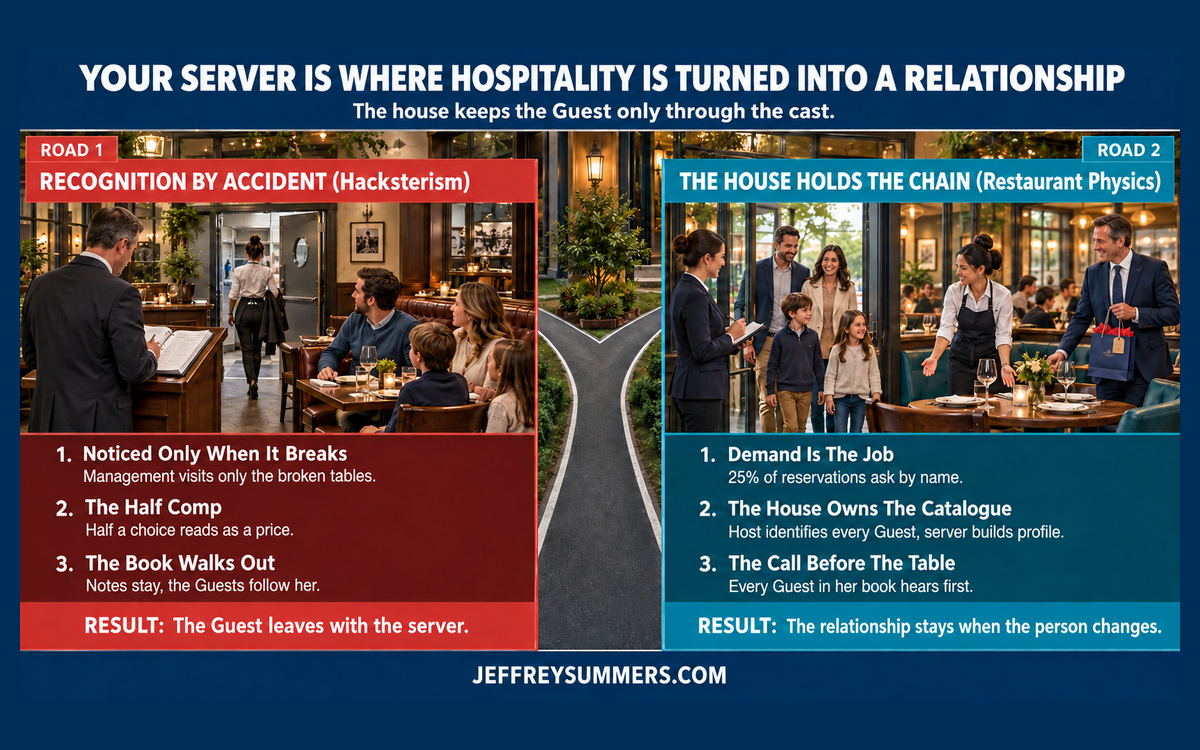
Every departure is a relationship at risk. The Guest who comes in and asks for a specific server is exposed the day that server leaves — and not exposed a little, because the thing she was returning for was never the menu. The regular who was known by the person at the door becomes an unknown Guest at that door the following week. A hundred and ten days of average tenure means the person who knows your Guests is being replaced before she has finished learning who they are.
Cast turnover and Guest retention are one architectural failure viewed from opposite sides. The operation that cannot build an environment its cast will grow inside cannot build an environment its Guests will return to, because the returning is produced by people who stay long enough to know them. That is not a coincidence of two problems. It is one mechanism with two symptoms, which is also why fixing it pays twice.
So I read cast turnover and Guest retention as a single number, and when an operator hands me a retention problem on one side, I go looking for its twin on the other. I have never failed to find it.
Where This Runs Across The Operation
The mechanism does not live in People. It runs on all five fundamentals, and the operator who addresses it in one place has addressed a fifth of it.
Perspective. The false definition of growth as accumulation, and the read that turnover is weather rather than output. Nothing downstream can be right while these are wrong, which is why this is the layer I work first.
Product. The GX degrades with every hundred-and-ten-day cycle, because the GX is produced by people whose capability is being reset before it compounds. An operation in permanent replacement mode can execute service and cannot reliably produce hospitality.
People. The five growth channels, open or closed. The fork. Whether intent that arrived at the back door is used or left to die of exposure.
Performance. Execution on the stage is capped by tenure and capability. Nobody performs at the level of a system they were never developed into, and the standard drifts down to whatever a permanently new cast can hold.
Profit. The leadership tax, camouflaged across the P&L, plus the compounding loss of the Guest relationships that walked out with the people who held them.
Five reads, one mechanism. That is what makes it an architectural issue rather than a departmental one, and it is why the operator who hands this to a general manager as a project has just delegated his own Perspective.
The Diagnostic
Run these against your own operation. Each one has a specific move and a plain read.
Test one — the named development test. Take three cast members currently on your schedule. For each, write the specific capability they are building right now, who is building it with them, and by when. Specific enough that someone else could deliver it. If you cannot complete all three from memory, the development architecture does not exist. It does not matter what your handbook says.
Test two — the pay-spread test. Pull the wage of your strongest cast member and your weakest in the same role. If the spread is small, your best are subsidizing your worst, and they know it. The spread tells you what your reward structure actually pays for.
Test three — the intent test. Ask three people what they want to be doing in three years, then ask yourself whether anyone in the building already knew the answer. If the answer surprises you, the relational channel is closed. If nobody has ever been asked, it was never open.
Test four — the calendar test. Look at last week’s schedule and find the time that was reserved for development rather than coverage. If there is none, coaching is not competing with coverage, it is losing to it by forfeit.
Test five — the lead test. Count your turnover among leads and kitchen managers, not just among hourly cast. If your developers are leaving at anything near the rate of the people they are supposed to be developing, your development capacity is being drained faster than you can install it, and hourly retention work will not hold.
Test six — the exit-reason test. Take your last five departures and re-file each stated reason under one of the five growth channels. If all five land in the same channel, you have found your specific closed channel. If they scatter across all five, the problem is not a channel, it is the architecture.
How the score sorts. Fail one or two tests and you have a specific closed channel and a clear repair. Fail four or more and you do not have a retention problem — you have an operation running on default with no development architecture in it, and the turnover is functioning correctly as its output. Pass all six and still have turnover, and the cause is somewhere I have not described here, which is worth knowing precisely because it is rare.
What You Do Monday Morning
Pick one cast member who left in the last six months that you wish had stayed.
Do not write down why they left. You already have that answer and it is the wrong one. Write down the specific development they were not getting from you: the skill nobody taught them, the context nobody gave them, the conversation nobody had, the next step nobody could name. Be concrete enough that a competent person could have delivered it on a date.
Then take that list to your current schedule and check it against the people on it. Does that development exist for any of them right now, in writing, with a name and a date attached?
If it does not, you did not lose that cast member to the labor market. You are also about to lose the next one, and you are now holding the specific list of what to build before that happens. That is one hour of work on a Monday, and it will tell you more about your turnover than a year of exit interviews.
The Closer
The labor market is weather. Weather is real, and it is what every operation in your trade area has to stand up in, including the ones keeping their people.
The question was never the weather. It was what you built for people to grow inside of, and whether you knew what growth was when you built it.
They did not leave because nobody wants to work anymore. They left because standing still is not a career, and nobody gave them anywhere to go.
Nobody wants to work for you. That is a harder sentence, and it is the only one of the two you can do anything about.
Digging Deeper
Every term used above is defined in my Knowledge Base: https://kb.jeffreysummers.com/
Terms used: Reward Structure Architecture, The Cast Member’s Fork, Desire Vector, Inculcation Arc, The Lost Opportunity Tax, Two Roads, Transactional Architecture, Relational Architecture, Guest Experience, The Summers Principle
The architecture taught in full, fundamental by fundamental: https://physics.jeffreysummers.com/
The Road 1 arbitrage prosecuted where it lives in the wild: https://hacksterism.jeffreysummers.com/
Discover more from Jeffrey Summers
Subscribe to get the latest posts sent to your email.