
Summary
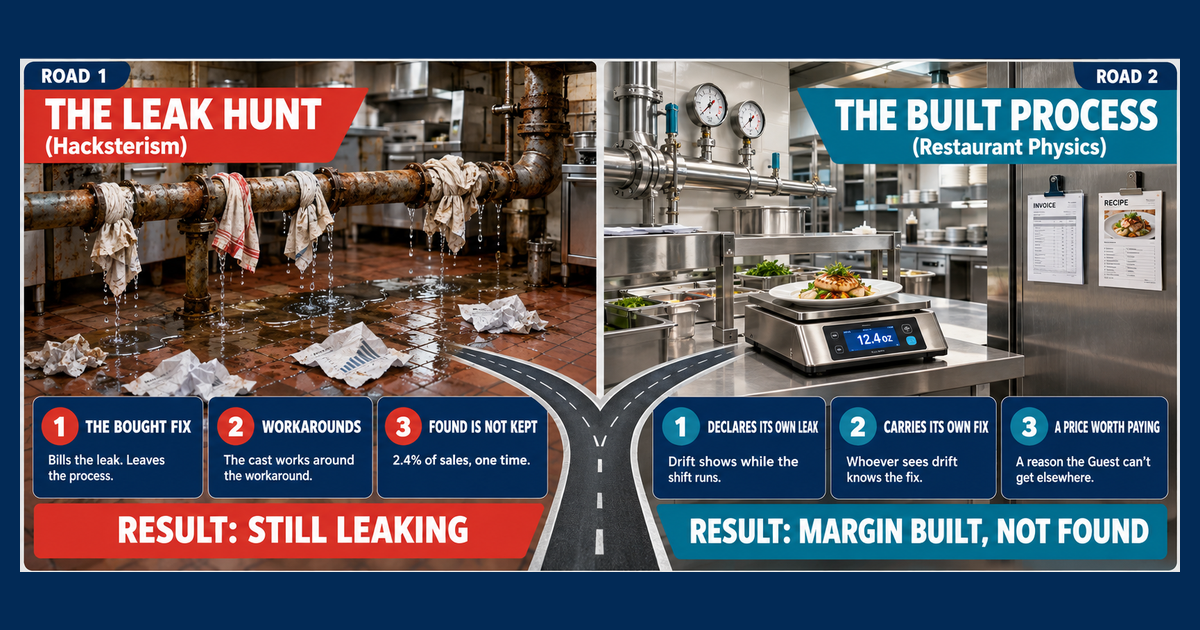
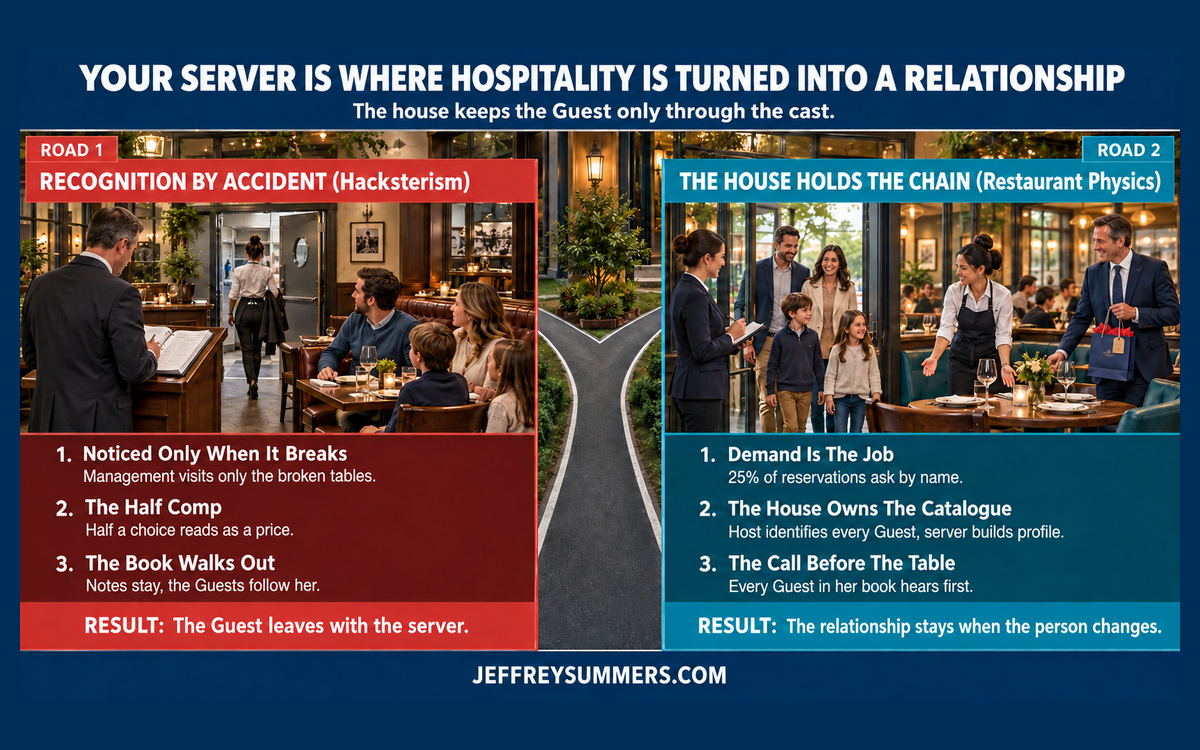
The house produces the hospitality, and the server is where it is turned into a relationship, so the Guest's relationship is with the house through the cast member who made the visit feel like something. The house only reaches that Guest through the cast. Most operations never designed for that, so recognition happens by accident, the server's book of business is invisible, and the Guests walk out the door with the server. The house that designs the chain, a server whose job is creating demand, a host who identifies every Guest, a catalogue the house owns and a plan for the day the best server leaves, keeps the relationship when the person changes.
Your server is where hospitality is turned into a relationship, so the Guest’s relationship is with your house through your server, and when the server leaves, the house keeps the Guest only if it built the hospitality she was turning into one.
Anthony Valletta, CEO and President of bartaco, posted a story this week about one of his managers. A family of four came in, regulars, and the manager said a quick hello at the door and moved on. Later their server, Emilia, pulled him aside to tell him how good they had been to take care of. He brought bags of tokens and koozies to the table, told them they had received an excellent review from their server, and then comped half their meal. The mother and her daughter teared up. Nothing had gone wrong. Valletta wrote that he had never seen anyone do it. I’ve seen a legion of versions of it for 45 years. And although it was a good effort, it fell short of the goal which is to build relationships, not transactions. Real loyalty gets rewarded with real [Meaningfully Differentiated Value], and the half comp turned that thank you into a transactional event. Nothing in the building made it happen, and nothing in the building makes it happen again. The industry’s answer to keeping recognition alive through turnover is technology and SOPs. Neither one holds a relationship. What holds it is a cast whose job is creating demand, a house that owns everything the cast learns about every Guest, and a plan for the day the server who mattered most leaves. What is at stake is every Guest in your best server’s book of business.
What Happened At bartaco
Here is what Valletta wrote, in his words: “Their server, Emilia, pulled him aside. She wanted him to know how good they’d been to take care of. Warm, easygoing, appreciative. The kind of table you’re glad you got.” The manager walked over and said, “I know this feels backwards, but you guys received an excellent review from your server tonight.” Then, “They laughed. Then they went quiet.”
Valletta named the problem underneath it exactly: “We have entire systems built for when a guest has a bad experience. Comps, apologies, manager visits, follow-up calls. A guest gets noticed by management almost exclusively when something breaks.” He is right. The industry built recovery systems and never built recognition systems, so the best Guests in the building are, in his words, “the ones you never say a word to.”
Look at what actually had to happen for that table to get recognized. Emilia read the table. Her read traveled to the manager, because her relationship with him was good enough that she bothered to tell him. And the manager acted on who the family was, not on anything that went wrong. Three links: the Guest to the cast, the cast to the house, the house back to the Guest. Break any one of them and the night never happens.
That is why Valletta’s close, “Ask your servers tonight who the best table in their section was. Then go tell that table,” is a tactic and not the design. It works in a house where the cast already reads tables and already trusts the manager with what it reads. In a house without that chain, it becomes an act of compliance, staged and scripted service, and not hospitality.
Never Comp Half
Then he comped half their meal, “as a thank you for the energy they brought into the building.”
I would never comp half. A half comp is what, exactly? Half a meaning? Half a choice? It makes no sense. Whether the table or the situation deserved it is a separate decision, and the house can argue that one all day. But once you decide to comp, do it with conviction. Comp the whole check, or leave money out of it and overwhelm the Guest with so much added value that the feeling of what they received swamps everything else. The tokens and the koozies were already doing that. The half comp put a price tag on it.
The behavioral research lines up behind this. Uri Gneezy and Aldo Rustichini titled their 2000 paper “Pay Enough or Don’t Pay at All,” and the finding is in the title: people offered small monetary incentives performed worse than people offered nothing, and among the people who were paid, more money did better. James Heyman and Dan Ariely found the same split in 2004 between what they called social and monetary markets. People will often work harder for nothing than for a small payment, and the moment a price gets mentioned, even the price of a gift, the exchange starts behaving like a market. Their words: mixed markets “more closely resemble monetary than social markets.” A half comp is a mixed market. It takes a social act, a thank you, and attaches a number to it.
Free is its own category. Kristina Shampanier, Nina Mazar and Ariely found in 2007 that a zero price “not only decreases its cost, but also adds to its benefits,” pulling demand far past what the price difference alone would explain. A full comp lands as a gift. Half off lands as a cheaper meal.
And the added-value side has a restaurant study behind it. David Strohmetz, Bruce Rind, Reed Fisher and Michael Lynn ran it in 2002 across 92 dining parties in Ithaca, New York: a piece of chocolate with the check raised the average tip from 15.06% to 17.84%. In their second experiment, tips moved with how much candy was given and how it was offered, and the authors put it down to reciprocity, not mood. A gift that arrives unexpected, offered personally, is answered in kind. That is what the tokens and the koozies were.
None of these studies tested a comp in a restaurant. The mechanism is what carries over, and it carries over cleanly: money in a social exchange either has to be enough to read as a gift, or it should not be there at all.
This is also not the comp my work prosecutes as [Positive Comp], the comp handed out to buy a return visit with no plan, no budget and nobody measuring whether it worked. That is a marketing decision nobody designed. What Valletta’s manager did was celebrate a table, and he had a reason. Whether a house celebrates is a design decision. How it celebrates, once it has decided, is conviction.
The Chain Runs Through The Cast
The Guest comes back for how the house made them feel, and the feeling reached them through a person. The Guest feels the relationship through the cast. The cast’s relationship is with the house. The house only ever reaches the Guest through the cast, which means the house is only as good with its Guests as it is with its people.
The standard answer to turnover is that technology and SOPs keep recognition alive no matter who is on the schedule. SOPs get compliance. Compliance is service. It will never produce hospitality. A section of my book says it in one line: great relationships can overcome bad systems, great systems can’t overcome bad relationships. The system can tell you which Guest is at risk. It cannot make the move.
The Server’s Job Is Creating Demand
The industry still describes a server’s job as taking orders and running plates. That is not the job. The job is creating demand: Guests who come back and ask for that server by name. Every Guest who does is a line in that server’s book of business, and the book is the most valuable thing the server brings to your house.
So in any house where reservations run, we demand that at least 25% of a server’s reservations ask for that server by name. Each business sets its own number, and 25% is my benchmark. A server should start getting requests within the first month working solo, and should be at the standard after six months solo. How fast it builds depends on the concept and on how long the rest of the cast has been there. A server under the standard gets the same as any server who cannot do the job, because the job requires the server to create that level of demand.
The other 75% is demand the house created. Your product, your reputation and your marketing brought those Guests in, and they did not ask for anyone. That is the raw material the server works with. The 25% is the share of it she turned into a relationship. A Guest handed to her from another server’s book belongs to the 75%, not the 25%. She did not generate that demand. Her job is to turn it into her own.
If Martha’s responsibility is to create demand, she has to have the authority to act on that demand generation. She has the autonomy to celebrate a Guest in any sense she sees fit, without going to find a manager first. Afterward she has the conversation with her lead, and that conversation teaches her what to look for and how to celebrate it. It is the Ritz-Carlton playbook, where any employee can spend up to $2,000 per Guest, per incident, without a manager’s approval, adapted to your context. This is growth, the increase of what Martha is capable of creating. This is agency. This is real empowerment. Emilia had to pull a manager aside before her table got recognized. A house that holds a server responsible for creating demand and makes her ask permission to act on it has handed her the job without the authority to do it.
In a walk-in house, the book shows in section requests instead. It is the hardest to track, because there is no reservation trail, and that is exactly why the house has to track it.
Compare that to where the industry sits now. My book puts the average server, by day 90, at the point where they are finally someone a Guest might recognize and ask for by name, and then they are gone. The house paid for 90 days of a book being built and kept none of it.
The House Owns The Catalogue
Nobody expects a server to remember every Guest. The note in the system is a memory aid, and a good one. But you can only craft a GX as good as the information you have on the Guest it is for. Information is the ceiling, and the cast decides how close the GX gets to it. Most of what matters is not in any system anyway. It is read at the table: the Guest, the Guest’s Guests, the occasion, the mood, how open the Guest is to play. The note tells the cast what the last visit was. The cast reads this one.
The building of that information starts at the door. The host identifies every Guest, writes it down and brings it to the server’s attention, and the server is off building the Guest profile from there. All of it gets catalogued for future use, and the house owns the catalogue. Not the reservation platform, which is [Relationship Arbitrage] from the outside. And not the server’s phone, which is the same loss from the inside.
As much as I hate loyalty programs, they do the tracking well. Tracking and rewards are two different mechanisms. The rewards train the Guest to come back for points. The tracking is just the house knowing who walked in. Keep the second and drop the first.
The catalogue also has to tell you who stopped coming. Want to know if you’re remembered? Stop coming in. The Guest who has stopped coming in has already asked that question, and the house that cannot see the gap has already answered it. Every Guest in the catalogue carries a visit rhythm. When that rhythm breaks, the house flags it and the server reaches out in her own name. And when the server is the one who left, that flag is the first sign her book walked out with her.
Every time I communicated with a Guest, it went out in the server’s name: “Sincerely, your favorite server, Martha.” That is real four-walls marketing, and no competitor can buy it, because no competitor has the relationship that Guest has with Martha. It is the most valuable asset in the building, and it is also the most exposed one, because it walks out the door with her.
The Day In Their Life
There will be pushback on giving a server that much authority. She will give away the house. She will buy her own tips. Not every server has the judgment. Those objections are pedestrian, and they come from the transactional mindset, the one that reads Martha as a cost to be controlled and not a relationship to be developed. I don’t expect a transactional mind to understand relational architecture. To understand a thing, you have to have experienced it, and most of the operators raising these objections never have. To understand it, you have to suspend the transactional mindset long enough to see what happened at that bartaco table: a family that had done nothing but be good Guests, and a mother and her daughter who teared up.
The answer to the objections is the job itself. Giving away the house is what the coaching is for. The conversation with her lead is where she learns what to look for and how to celebrate it, and that is what growth is. Judgment is the level of quality server you should seek to employ. If she doesn’t have that level of judgment, why is she on your stage?
She will buy her own tips? Then she has a short-term mindset and shouldn’t be employed, because she hasn’t understood the mission of the business. She also has to be held accountable for the investment in the Guest. What does that ROI look like? Did that Guest come back? Did they bring someone? Did they start asking for her by name? Every celebration gets booked and tracked, and the conversation with her lead reads the return. These are mature decisions that only a mature mind can grasp, let alone solve.
Then comes the question nobody asks. If we do that tonight for our best Guest, what do we do for an encore? What do we do ongoing? This is the architectural problem you have to solve with your product. A bigger gift every visit is a treadmill, and a treadmill of bigger gestures is a transaction, buying the feeling one visit at a time. The encore is the relationship deepening, built into the product, so the next visit picks up where that night left off.
I don’t do recognition or reward. I do celebration, which means you need a reason. The reason starts with the question Martha asks herself at the table. Are these great Guests tonight, or great Guests all the time? And how often? The celebration has to take its context from the Guest’s organic loyalty to the business, and the catalogue is where Martha finds it.
Then it has to answer the day. Every day is a day in the life of a Guest: first date, last date, birthday. Every visit either adds to that day or takes from it. Koozies may be appropriate, but at what level of engagement from both sides of the table? A Guest who just buried a parent at table 12 needs something greater than a koozie. What the house does answers the day in that Guest’s life, within the context of that Guest’s relationship with the business. A regular who has been coming in for years has given the house standing in that day. A stranger has not. You don’t just walk around cemeteries passing out business cards.
No schedule can read table 12. The catalogue tells Martha what the relationship is, and the table tells her what the day is. That is why the authority sits with her.
When Martha Leaves
When a great server leaves, her book of business leaves with her. The notes stay in your system. The Guests follow her.
Think about what happens when a law firm loses its best lawyer. The other partners do not wait for the clients to call. They pick up the phone that week and shore up every relationship that lawyer carried. Your house owes the same call to every Guest in Martha’s book, and it has to land before the Guest finds out at the table.
What gets said depends on why she left. She left well, for school, a move or a promotion. She went to a competitor down the street. She was let go. She disappeared without a word. A few things hold in every one of those. The house reaches the Guest first. The house never says a word against her. And the conversation is about the relationship: what it gave the Guest, how it felt, and why those things stay, because they are in the house’s DNA and were never only hers.
Then the house hands the Guest to a named cast member and sets the expectation in that same call. It will not be Martha. It will be a different person with a different personality, and a different relationship is a better relationship, not a lesser copy of the old one. The call makes the promise. The next visit keeps it.
None of it is guaranteed. Whether that Guest stays depends on how fast the house moves and how.
Keep Martha First
You do not minimize turnover. You design against it. Turnover is an output of how the house hires, develops and pays its cast, and [Default Architecture] produces it on schedule. The [Designed Architecture] version starts with Martha herself: what are her growth goals? Ask, and then build toward them. If her goals lead out of your house, build toward them anyway. Loyalty exists on both sides of the table, and a server who leaves well leaves her Guests with a house that treated her the way it asked her to treat them.
That is what makes the departure call true when the house makes it. The Guest was not loyal to Martha in spite of the house. The house was the reason Martha was worth being loyal to.
The Diagnostic
Four reads to run on your own house this week.
The Request Test. Pull last period’s reservations and count, for each server, the share that asked for that server by name. Yes if your servers sit at or above the standard you set. No if you have never run the count.
The Host Test. Ask your host who sat in your best server’s section last Friday, by name. Yes if the host can tell you and it is written down. No if the answer is “the 7:30 four-top.”
The Catalogue Test. If your best server quit tonight, could you list every Guest in her book by tomorrow morning, from the house’s records and not her phone? Yes or no.
The Celebration Test. When did your cast last celebrate a table where nothing had gone wrong, and what was the reason? Yes if it happened this week and the server made the call. No if the only tables anyone visits are the broken ones.
Four yeses, and the house holds the chain. Any no, and your Guests belong to whoever happens to be serving them, for as long as that person stays.
The Closer
Valletta’s manager did something right once, on instinct, because one server trusted him enough to tell him about a table. The house that designs for it does it every night, because the host knows who walked in, the server is building a book the house can see, the catalogue belongs to the house, and the server has the authority to celebrate a table, for a reason, before anything breaks. The chain runs through the cast whether you design it or not. Design it, and when Martha leaves, the house keeps the relationship she built. Leave it to instinct, and the relationship leaves with her, because your server is where hospitality is turned into a relationship.
What You Do Monday Morning
Pull last period’s reservations and count, server by server, how many asked for that server by name. Rank the list. Take the top name and make sure every Guest in that server’s book is in a catalogue the house controls, with names, occasions and notes. Then sit down with that server this week and ask one question: where do you want to be in a year?
Digging Deeper
Positions on the record:
-
The Myth Of Retention — https://physics.jeffreysummers.com/the-myth-of-retention-2/
-
Demand You Create Is The Only Demand You Own — https://physics.jeffreysummers.com/demand-you-create-is-the-only-demand-you-own/
-
Agreeing That Service Is Not Hospitality Costs You Nothing — https://jeffreysummers.com/agreeing-that-service-is-not-hospitality-costs-you-nothing/
-
Loyalty Programs Don’t Build Loyalty — https://hacksterism.jeffreysummers.com/loyalty-programs-dont-build-loyalty/
-
Driving (REAL) Guest Loyalty — https://physics.jeffreysummers.com/driving-real-guest-loyalty/
-
Nobody Wants To Work Anymore — https://jeffreysummers.com/nobody-wants-to-work-anymore/
Terms used in this piece: Positive Comp, Meaningfully Differentiated Value, Relationship Arbitrage, Default Architecture, Designed Architecture. Definitions in the Knowledge Base (https://kb.jeffreysummers.com/).
Sources Cited In This Piece
-
Anthony Valletta, LinkedIn post, October 2, 2026 — the bartaco manager, the server Emilia, the tokens and koozies, the half comp; quoted: “Their server, Emilia, pulled him aside. She wanted him to know how good they’d been to take care of. Warm, easygoing, appreciative. The kind of table you’re glad you got.”; “I know this feels backwards, but you guys received an excellent review from your server tonight.”; “They laughed. Then they went quiet.”; “as a thank you for the energy they brought into the building”; “We have entire systems built for when a guest has a bad experience. Comps, apologies, manager visits, follow-up calls. A guest gets noticed by management almost exclusively when something breaks.”; “the ones you never say a word to”; “Ask your servers tonight who the best table in their section was. Then go tell that table.” — https://www.linkedin.com/in/anthonyvalletta/
-
Uri Gneezy and Aldo Rustichini, “Pay Enough or Don’t Pay at All,” The Quarterly Journal of Economics 115(3), August 2000 — subjects “who were offered monetary incentives performed more poorly than those who were offered no compensation”; “In the treatments in which money was offered, a larger amount yielded a higher performance” — https://academic.oup.com/qje/article-abstract/115/3/791/1828156
-
James Heyman and Dan Ariely, “Effort for Payment: A Tale of Two Markets,” Psychological Science, 2004 — “people sometimes expend more effort in exchange for no payment (a social market) than they expend when they receive low payment (a monetary market)”; “mixed markets (markets that include aspects of both social and monetary markets) more closely resemble monetary than social markets”; candy offered as a gift versus candy with its price mentioned — https://web.mit.edu/ariely/www/MIT/Papers/2markets.pdf
-
Kristina Shampanier, Nina Mazar and Dan Ariely, “Zero as a Special Price: The True Value of Free Products,” Marketing Science 26(6), 2007 — zero pricing “not only decreases its cost, but also adds to its benefits”; affect as the most likely account — https://scholars.duke.edu/publication/859276
-
David B. Strohmetz, Bruce Rind, Reed Fisher and Michael Lynn, “Sweetening the Till: The Use of Candy to Increase Restaurant Tipping,” Journal of Applied Social Psychology 32(2), 2002 — 92 dining parties, Ithaca, New York; mean tip 17.84% with a piece of chocolate versus 15.06% without; in Experiment 2, tips varied with the amount of candy and the manner it was offered; reciprocity favored over mood — https://onlinelibrary.wiley.com/doi/abs/10.1111/j.1559-1816.2002.tb00216.x
-
The Ritz-Carlton $2,000 rule — any employee may spend up to $2,000 per Guest, per incident, without manager approval — https://customersthatstick.com/blog/the-ritz-carltons-famous-2000-rule/
Discover more from Jeffrey Summers
Subscribe to get the latest posts sent to your email.