
Summary
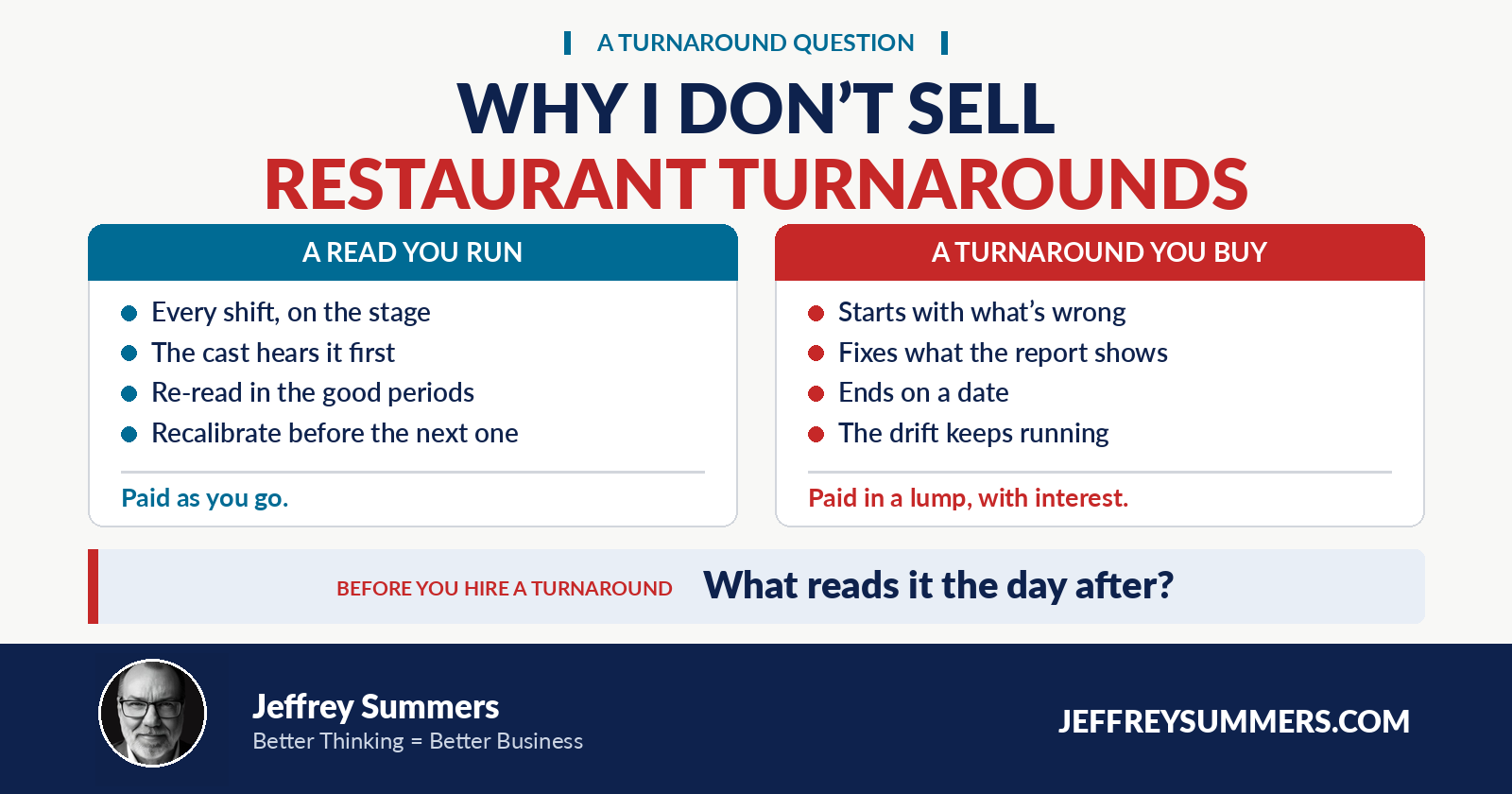
When I am called into a restaurant that has spent years fixing leaks, the first work is not fixing anything. It is undoing the fixes, because every one of them was a workaround.
When I am called into a restaurant that has spent years fixing leaks, the first work is not fixing anything, it is undoing the fixes, because every one of them was a workaround and the cast has built their own workarounds on top of them.
Line up all of an operator’s fixes and they look like a bunch of discombobulated band-aids with no flow to their logic. Each one was bought or built against one leak, alone, with no view of the others. Together they create friction points for a cast who literally cannot think straight, because they are carrying every one of those fixes at once in the middle of a shift. The operator paid for each fix. He pays again every shift in a cast working around them. And he pays a third time when someone like me has to take them apart before anything can be built. What is at stake is every period of the engagement, because nothing I design holds on top of a pile nobody can see.
How The Pile Gets Built
It runs the same way in every operation I walk into.
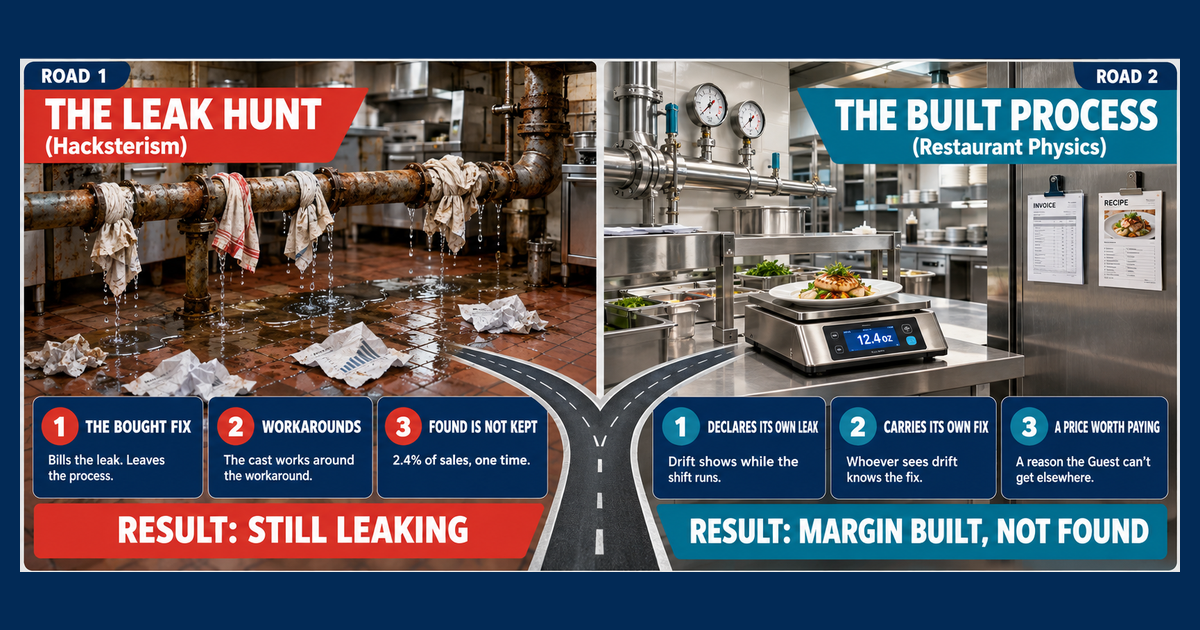
The operator designs a process once, or defaults into it. It develops a leak, the 5 to 8 percent every ad in the feed is selling. The leak hurts enough to get him off the nail. [Repairman Syndrome] takes over, and he treats the leak instead of the process. He buys a fix, and the fix is itself a workaround. It routes around the leak and never innovates it out of the process. The cast builds their own workarounds around the bought workaround, because it does not fit the way the shift actually runs. And the result is friction from production to service, with the leak still sitting at the bottom of the pile.
Then the next leak hurts, and the chain runs again.
The Cast’s Workarounds Are The Biggest Problem
The operator’s fixes are the first layer. The cast’s workarounds are the second, and the second is the worse of the two.
The cast builds them because there is no coherent approach to any of the base issues. Nobody designed them, nobody wrote them down, and the operator cannot see them. But from production to service, the restaurant actually runs on that second layer. The recipe card says one thing, the prep list says another, and the cook does a third thing because that is the only way the ticket gets out. Every one of those is a friction point, and they compound at every point in the flow of the business.
That is also why the next leak seller makes it worse. He fixes what he can see, which breaks a workaround the cast depends on, and the cast builds another one.
My work has names for what that pile becomes. [The Bandaid Scaffolding] is each bandaid meant to be temporary, accumulating into load-bearing structure that obscures the operation from the operator’s own read. [Complexity Decline] is decay through compounding action, every workaround, every added process, every undocumented exception, until the system can no longer produce the experience it was built to produce. The operator who reaches it is usually the busiest person in the building.
Why I Cannot Just Pull Them Out
The workarounds are load-bearing now. The shift runs on them. Pull one out without replacing the process under it and the shift breaks, because the cast just lost the one way they had found to get through it.
So the rework runs in order. Find the workaround. Find the fix it was built around. Find the process the fix was patched onto. Then redesign that process so it fits the operation and reads itself, and only then take the pile off it.
How I Read It
I do a lot of reading of people and how they move through the shift, more than of the work they do. The workarounds are where the cast goes around the process instead of through it, and that shows up in how they move long before it shows up in any report.
Once I have found a leak, I ask two questions. Why didn’t the existing process fix it? And why did it spring in the first place? The first question almost always lands on a process that was never built to read itself. It was designed once, or defaulted into, and left alone, so it has no way to catch its own drift. The second almost always lands on a process that no longer fits the operation, a default that never fit, or a design for a menu, a volume, a cast, or a price that has since changed.
That gives me the test I run on every process in the building. If it cannot declare a leak on its own and does not have a fix for it, it is a bad process. And a process whose leaks get discovered after the fact, at period close, by the numbers or by somebody’s software, has two design failures, not one. It leaks, and it cannot see its own leak.
The operation I walk into usually fails that test almost everywhere. Take the costing on one $18 plate that the card calls 30 percent. Cost the protein at usable weight instead of purchase price, read the portion on a busy Saturday, run the check after the comp, run it after the delivery commission, and the same plate runs 36.7 percent, 45.6 percent, 45.8 percent, and 52.4 percent. Not one of those was declared by the process that produced it.
What It Costs The Practice
Every engagement on one of these operations starts behind zero. The first periods do not go to building anything. They go to undoing years of leak fixing so there is a process underneath to build on.
That is the part the operator has trouble reading. He called because he wanted the margin fixed, and the first thing he sees is his fixes coming out. Some of them he paid good money for. The work is to take every one of them seriously, understand what it was holding up, and replace the process under it with one that makes the workaround unnecessary. That is [Relational Innovation]: asking whether the broken part belongs in the system at all, and producing actual redesign rather than better patching.
A leak hunt returns the operation to where it was. The rework returns it to a process that can see itself.
The Closer
Every fix I find when I walk in is a workaround, and every workaround is a process somebody decided to route around instead of redesign. The leak economy sold the operator the first layer, the cast built the second, and the leak is still at the bottom of the pile. The rework is running that chain backward: past the workarounds, past the fixes, to the process, and innovating the leak out of it. That is what I have to undo before I can fix anything.
What You Do Monday Morning
Pick your top seller and walk it from the back door to the table. At every step, write down two things: every fix that has been installed on that step, and every workaround the cast uses to get through it. Get the second list from the cast, not from the manual. Ask the person doing the step what they do when it does not work. Then, for each workaround on the list, ask the two questions. Why didn’t the process fix it, and why did it spring?
Digging Deeper
Positions on the record:
- 5 Money Leaks I Found Opening A Jar Of Peanut Butter — https://hacksterism.jeffreysummers.com/5-money-leaks-i-found-opening-a-jar-of-peanut-butter/
- Margin Is Built, Not Found — https://physics.jeffreysummers.com/margin-is-built-not-found/
- Why Most Restaurant Consulting Makes It Worse — https://jeffreysummers.com/why-most-restaurant-consulting-makes-it-worse/
- You Keep Buying The Same Process Under Different Names — https://jeffreysummers.com/you-keep-buying-the-same-process-under-different-names/
- Your Cast Is Not The Problem. Your System Is. — https://physics.jeffreysummers.com/your-cast-is-not-the-problem-your-system-is/
- The Hack Roster: The Repair Market Runs Because Restaurants Are Multi-Domain Systems Being Sold Single-Domain Fixes — https://hacksterism.jeffreysummers.com/the-hack-roster-the-repair-market-itself/
Terms used in this piece: Repairman Syndrome, The Bandaid Scaffolding, Complexity Decline, Relational Innovation. Definitions in the Knowledge Base.
Discover more from Jeffrey Summers
Subscribe to get the latest posts sent to your email.