
Summary
Is your restaurant growing, and is it the right growth? Most operators have nobody to ask them. Why a business coach is the partner who teaches you to read it.
The two biggest questions in any restaurant are whether it’s growing and whether it’s the right growth, and most operators have nobody whose job is to ask them, let alone answer them.
This week MIT Sloan Management Review ran a column by Jim Detert and Rahul Bhandari arguing that every high-performing leader needs a pacer: a trusted person who tells him when to speed up, when to slow down and when to hold. The professional coach is one of the five kinds they name. Their survey says most leaders run at the wrong speed and most have nobody pacing them, and those are leaders inside organizations with boards, peers and bosses around them. They call that person a pacer. For a restaurant operator, that person is a business coach, and the operator usually has less around him than they do. Nobody asks him whether he’s growing, or whether it’s the right growth and not sales bought instead of capability built, a change faster than his business can carry, or a location the lease chose for him. Nobody teaches him how to read the business and plan how to leverage that for growth. A business coach is an ongoing coaching partner who does exactly that, and pace is one of the things he helps the operator read.
Their Own Evidence Points At The Empty Seat
Detert and Bhandari surveyed 125 employees and asked each one to describe a current or former leader. More than 93% described a leader whose pace was often at odds with what the situation needed. Three quarters of those leaders ran too fast and one quarter ran too slow. Only 40% had a pacer.
Look at what the ones who had help actually had. Bhandari, as a CEO, had a board member who asked him one question every time he brought a new initiative forward: “What are you willing to stop doing to make room for this?” A respondent whose leader had an effective pacer put it this way: “It’s harder to ignore or change performance metrics in real time when you’ve agreed to hold to a pace.” In both cases somebody sat in a seat whose job was to ask the question the leader wasn’t asking himself.
Now ask who sits in that seat for a restaurant operator. Who asks him what he’ll stop doing before he adds the catering program, the new daypart or the second location? Who holds him to the plan when the period gets hard? Who teaches him how to read the business and plan how to leverage that for growth? For most operators the answer is nobody.
Nobody Above The Operator Is Developing The Operator
The independent owner has no board. The franchisee has a franchisor, and the field visit checks the brand’s standards against his building. It isn’t built to develop him. The multi-unit GM gets area manager visits, and most of those end the same way: the area manager walks out with the diagnosis, the priority, the owner and the follow-up date, and the GM walks out with a to-do list. That visit develops the area manager. The GM learns to wait for the next one.
Everyone else in the operator’s world is selling him something. The vendor sells the product. The platform sells the subscription. The advisor on a clock sells hours. None of them is paid to make him a better operator, and none of them is there when he slides back into the habits he was trying to break. Nobody teaches operators to grow. That’s the whole reason my practice exists.
There Are Only Two Answers
[No Static Achievement] holds that nothing an operation has built can be held without continuing to earn it. There is no third state between growing and contracting. The operator who says he’s holding steady is contracting and calling it stability.
Most operators answer the question with sales, and sales is the wrong number. Sales can be bought with a promotion, a platform or a discount. Growth is capability the operation owns and can put to work: a better read on the Guest, an experience the cast delivers on the hardest night, managers who can run more than they’re running, systems that hold under more volume, and margin that funds the next step. It’s also every opportunity he could leverage and doesn’t, from an underserved market to the next location his capability is ready for. An operator can post a record sales period and still be contracting in every one of those.
The greatest leak in your business is not fully utilizing your own capabilities to maximize your growth. That leak has a name: the [Lost Opportunity Tax], the revenue and value the operation was capable of producing but didn’t, because an upstream gap closed off the opportunity before it could land. It never shows up as a line on the P&L. It shows up as the sales that never happened.
No Growth And Wrong Growth
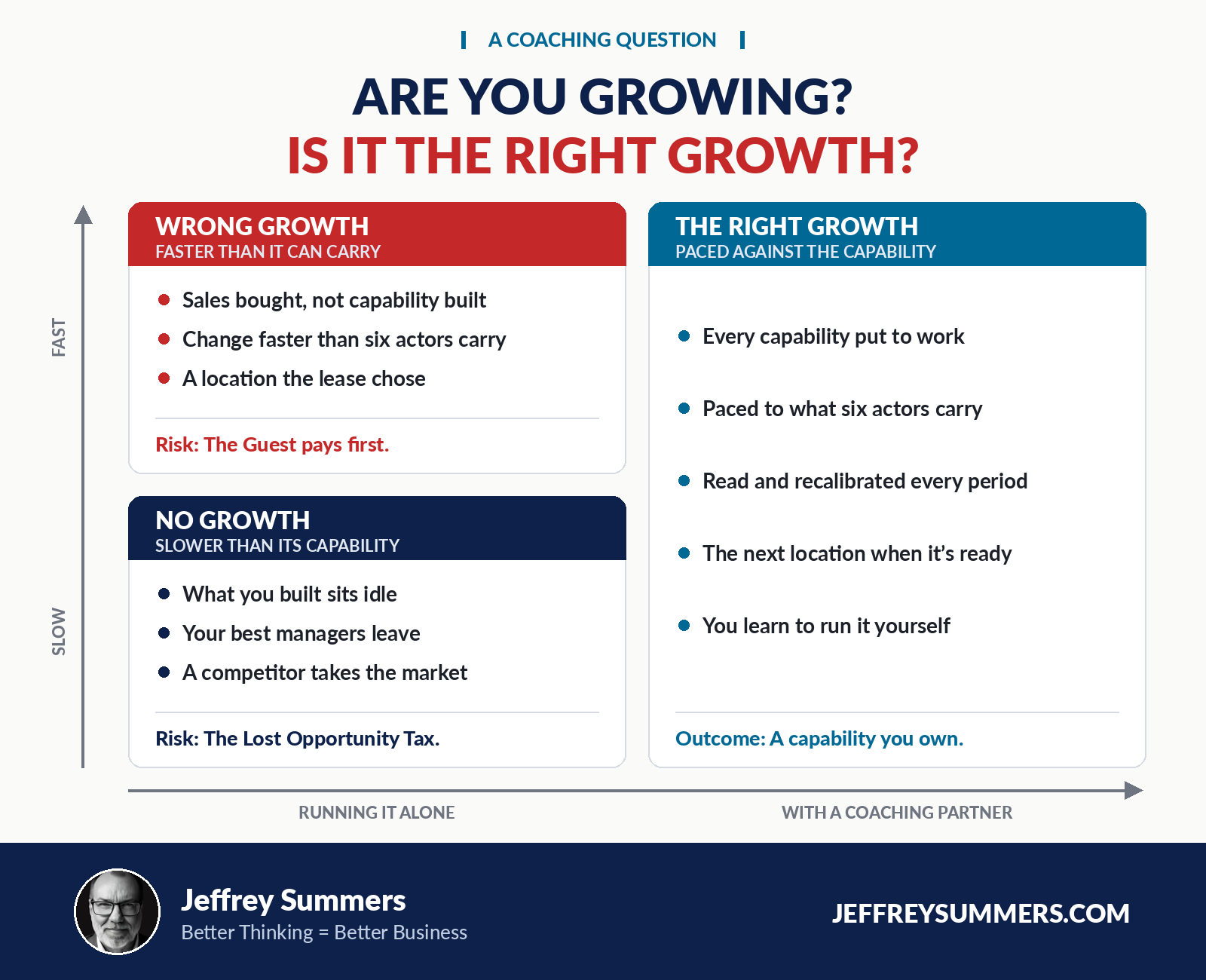
No growth is the operator who knows he isn’t growing, or tells himself he’s holding steady. It shows up in every Fundamental. In Perspective, it’s a market position he doesn’t extend, so a competitor takes it. In Product, a kitchen and an experience that could deliver more Guests, more dayparts or more occasions get delivered by someone else. In People, he develops a kitchen manager ready to run a building, and if there’s no building for him, he leaves. That’s the growth departure, the cast member who outgrew the role because you developed him well. In Performance, systems and operational architecture that could carry more volume, or a second location, sit idle and drift. In Profit, margin and cash that could fund the next step get spent on whatever is in front of him that period. Growing slower than his capability isn’t slow growth. It’s no growth in every place the capability is leaving.
Wrong growth looks like growth and isn’t. It’s sales bought with a promotion, a platform or a discount instead of capability built. It’s a change faster than the six actors can carry: the operator, the business, the Guest, the cast, the vendors and the community. It’s the next location opened because the lease brought it, not because the capability was ready. It’s the record sales period with the operation contracting underneath.
Both pay the tax. Wrong growth is the more dangerous of the two, because the numbers say he’s growing, so nobody asks.
Pace Is One Thing The Coach Reads
Look at the warning signs Detert and Bhandari give for a leader running too slow: competitors launch what you’re still studying, and your default answer to a new idea is more analysis. For a leader running too fast: the team keeps asking for clarification on priorities the leader thought were obvious, and major decisions get reversed inside 90 days. Every operator reading that list recognizes one side of it. Almost none can tell which side he’s on this period, because he’s the one moving.
Pace has two edges. The slowest pace the operator can afford is the one that puts to work everything he’s built across all five Fundamentals. The fastest is the one all six actors can carry. Change the experience faster than the cast can deliver it and the Guest meets the new version on the night it doesn’t work. Change it slower than the market is moving and he meets your competitor’s version first. Run every significant change through the [Six-Actor Test] before you commit. Every actor needs a real answer to what it gets from the change. A missing answer is work to do before you fund it.
[Coherence Collapse] holds that growth pace is an operating variable the operator controls. [Road Remission] holds that he should choose it against what the operation can carry, not against industry benchmarks or investor pressure. Most operators never treat it as a variable. The lender, the lease, the development schedule or the trend sets it for them.
The coach reads pace with the operator against the period plan. There are thirteen 28-day periods a year. Plan the period, execute it, run [The Re-Read] at close and recalibrate the next one. Was he early or late, and what number told him so? What capability did he build this period, and what did he leave unused? What is he willing to stop doing to make room for the next step? Over enough periods the operator starts asking those questions before the coach does.
When The Building Runs Out Of Room
At some point the building can’t hold what the operator has built. Every daypart that makes sense is open, every occasion he can deliver is on the books, and the capability keeps growing. Another location is how he puts it to work. The capability decides when to open, and the opportunity just showing up doesn’t.
The location has its own window. Open too early and what works in the first building hasn’t been designed to travel. The bench isn’t ready to run two buildings, the six actors can’t carry it, and both buildings slip. Open too late and the managers he developed leave for someone who has a building for them, the cash sits idle, and a competitor takes the market. Most operators open the next location when the lease, the lender or a broker brings it to them, without asking whether their capability is ready to carry two buildings.
What A Coach Reads That The Operator Can’t
The operator is the one person who can’t see the building clearly, because he built most of what he’s looking at. The standards formed by habit. The systems that piled up without being chosen. The leadership behaviors inherited from whoever ran the place before him. The story he tells himself about the operation that has never been checked against what it actually produces. [The Summers Principle] holds that every outcome traces to design or default. The coach’s first job is to ask the question the building can’t ask itself: is what you’re running by design or by default?
The harder job is the instinct. Understanding the right posture isn’t the same as owning it. Under pressure the operator slides back into the posture that’s deepest in him. Rebuilding that takes being held in the new posture through real pressure by someone who can name the slide back when it happens and pull him out before the default takes hold. A book can’t do that, and a workshop can’t either. A coach can.
Why The Coach Has To Know The Clock
Detert and Bhandari name the risk with the professional coach themselves: he “may not have an industry-specific clock speed.” In this business that clock is the whole job. A coach who has never stood on a stage during a rush can’t tell a GM how fast his cast can absorb a new service step. A coach who has never watched a bench of managers get stretched across two buildings can’t tell an owner whether the second location is early. The operator needs a coach who has run the clock, not one who has read about it.
What A Coaching Partner Does
My coaching is a partnership with you and your business. I teach you how to read the operation across all five Fundamentals, find the capability you aren’t putting to work and the gaps that are taxing your growth, and plan how to leverage both. Then I stay in it with you, period after period: reading the pace with you, holding the plan when the pressure says drop it, and asking the questions nobody else in your world is asking. What comes out of it isn’t a solved problem. It’s an operator who reads his own business, decides under pressure from design instead of default, and grows it to what it’s capable of. Better thinking, better business.
We run it the way every turn of the [Operating Helix] runs: we read, we plan, we execute, we re-read, we recalibrate. Every turn increases a capability your business didn’t have before: you running that loop yourself. That’s where most coaching ends. It’s where ours changes. You run the loop, and I’m the partner you bring the next turn to: the next location, the market you haven’t served, the pace you can’t see from inside. Each turn of the helix sits above the last one, and so does the work we do together.
That’s what you’re buying when you hire me. Not my hours, not my advice and not a fix. A capability.
They also say that “over time, the best pacers make themselves less necessary.” That’s my standard. I stay with each capability until it’s ingrained, deep enough that you run it under pressure without me, and then we move to the next one.
The Diagnostic: Three Questions To Ask Yourself
Are you growing, and is it the right growth? Answer with capability, not sales. Read: if the only number you can name is a sales number, you can’t answer either one.
What have you built that you aren’t using? Go through all five Fundamentals. Read: anything on that list is leaving, getting spent or getting taken. That’s your Lost Opportunity Tax.
Who teaches you how to read the business and plan how to leverage that for growth? Not who audits you, sells to you or reports on you. Read: if you can’t name a person, the seat is empty.
Three clear answers and the seat is filled, whether it’s a coach or not. One or two and you’re carrying part of the read alone. None and you’re running the operation on an instinct nobody has checked.
The Closer
The column closes on a runner: “When the pacer worries about the tactics and the splits, you can win the race.” A restaurant has no finish line, and the race runs again every shift. The operator without a coach runs it reading his own splits from inside the race. Every period he grows slower than his capability, he pays the [Lost Opportunity Tax] on the growth an upstream gap closed off. Every period he grows faster than the operation can carry, the Guest pays first and he pays after. A coaching partner finds the gaps he can’t see from inside, teaches him to read them, and plans how to close them at a pace the business can carry. What the operator buys is the capability to do that himself. Every period he runs without it, he pays the tax again.
What You Do Monday Morning
Write down one capability your operation has built that it isn’t using, in any of the five Fundamentals. Then write down the name of the person who teaches you how to read the business and plan how to leverage that for growth. If you can’t write a name, that’s your answer.
Digging Deeper
Positions on the record
- Coaching — https://jeffreysummers.com/coaching/
- The Operator’s Contract — https://jeffreysummers.com/the-operators-contract/
- Why I Don’t Do Timed Contracts — https://jeffreysummers.com/why-i-dont-do-timed-contracts/
- 5 Money Leaks I Found Opening A Jar Of Peanut Butter — https://hacksterism.jeffreysummers.com/5-money-leaks-i-found-opening-a-jar-of-peanut-butter/
- MUM Visits Checklist — https://jeffreysummers.com/docs/mum-visits-checklist/
- Where’s The Plan? Part 1 — https://physics.jeffreysummers.com/wheres-the-plan-part-1/
- Why Most Restaurant Consulting Makes It Worse — https://jeffreysummers.com/why-most-restaurant-consulting-makes-it-worse/
Terms used in this piece: No Static Achievement, Lost Opportunity Tax, Six-Actor Test, Coherence Collapse, Road Remission, The Summers Principle, Operating Helix, The Re-Read. Definitions in the Knowledge Base.
Sources Cited
- Jim Detert and Rahul Bhandari, “Why Every High-Performing Leader Needs a Pacer,” MIT Sloan Management Review, October 14, 2026 — https://sloanreview.mit.edu/article/why-every-high-performing-leader-needs-a-pacer/
Discover more from Jeffrey Summers
Subscribe to get the latest posts sent to your email.