
Summary
How a restaurant consultant plans an open: the model before the site, the menu before the building, the Team before the cast, and no lease the numbers don’t clear.
The math I run before I sign anything, and why the lease waits for it
I don’t sign a lease until the model says the occupancy cost fits, because the lease is the most important profit document in the business, and once it’s signed, the margin is mostly decided.
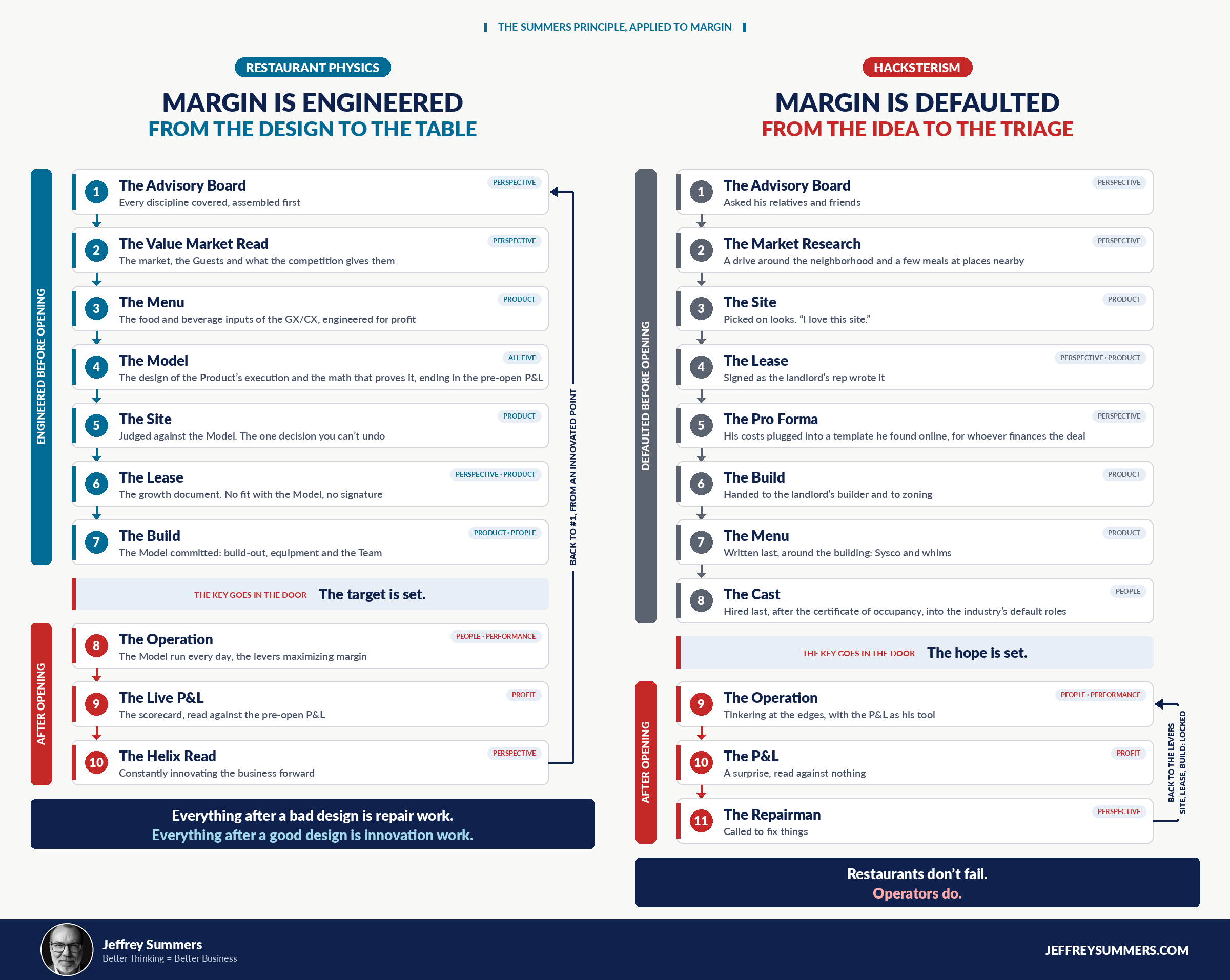
That’s how I plan an open. I work the math first: occupancy costs, the menu and the layout, then I run the numbers against what the business needs to be profitable. I calculate the per-person average, the average check and the break-even before the first hour of operation. If the numbers don’t clear, the design changes. If the design can’t change enough, I walk. Anything else is wishful thinking, and hope ain’t a plan. What it costs my practice is the operator who has already fallen in love with a site and wants me to make it work. I’ll help him read it. I won’t help him sign it against the numbers.
Perspective: The Read I Can’t Run Alone
I start every open by assembling the advisory board, because the open touches more disciplines than any one person can read. I sit on it as the consultant, and the GM sits on it from the start. Legal, accounting, finance, insurance, brand, technology, construction, equipment, a tenant-rep broker who works for the operator and not the landlord, an architect, an MEP engineer, an interior designer and a general contractor fill the rest. One consultant with successful openings behind him can cover a lot of that board. Legal and finance always need their own professionals.
Then I read the market before I read a single site: who the Guests are, what they value, what they’ll pay relative to what they get, and what the competition already gives them. Everything after that gets built for a specific Guest in a specific market.
Product: The Menu Decides The Building
The menu comes before the building, because the menu decides the building. I can’t know what kitchen, equipment, square footage, seat count or table mix the business needs until I know what it’s selling. The menu is the second most important profit document. It has to hold costs and engineer profit at the same time, and I price it with the [X Factor], so the price carries the full burden of the business as modeled, not just plate cost.
Then I build the model: the design of the Product’s execution and the math that proves it. It all lands in the pre-open P&L, built forward from the design and real costs, with every cost included. Only then do I look at sites, and each one gets judged against the model. Does the traffic carry the sales? Is there delivery parking and pickup access for the channels the model includes? Does the space hold the right mix of two-tops and four-tops? A site is the one decision you can’t undo. When a site fits, I negotiate the lease as the growth document, with every tool the model needs written in. If the lease doesn’t fit the model, there’s no signature.
People: The Team Before The Cast
The model defines roles before anyone is hired. Unit leadership is the Team: the GM, already on the board, plus the AGM, the Culinary Lead(s) and the front-of-house lead(s). I put the Team together first, before the doors open, and the Team hires and trains the cast. That way the cast and the production get built into the design rather than around a building somebody else finished.
Performance: The Levers Inside The Design
Once the key goes in the door, the target is set. The levers run every day: scheduling, purchasing, portioning, the daily cost checks. They maximize the margin the design made room for. They can’t create margin the design never left. The menu keeps moving inside the operation, re-engineered seasonally and priced on the fly as costs and the market move. When an outside event hits, like a commodity spike or a wage change, it hits one or two levers, and the model tells me which ones and by how much. I recalibrate against a plan instead of guessing against nothing.
The model also holds room to be wrong. Every decision in an open is a bet placed before the market settles it, so I build in [Uncertainty Capacity] (cash reserve, bench depth, operator time) rather than assume every bet lands.
The Closer
Profit holds no decisions. It’s the scorecard for the decisions I made in Perspective, Product, People and Performance, and I read the live P&L against the pre-open P&L, line by line. Every gap points back to the Fundamental that produced it. That’s the whole method: the model before the site, the menu before the building, the Team before the cast, and no lease that the numbers don’t clear. Margin is engineered before the first Guest walks in, or it’s defaulted. Hope ain’t a plan.
What You Do Monday Morning
If you haven’t signed yet, build the pre-open P&L forward from real costs before you sign anything, and don’t sign until it clears. If you already have, put the pro forma you opened on beside last period’s P&L, line by line. The biggest gap is the decision to go back to.
Digging Deeper
Positions on the record
- Margin Is Engineered — https://physics.jeffreysummers.com/margin-is-engineered/
- Margin Is Defaulted — https://hacksterism.jeffreysummers.com/margin-is-defaulted/
- Your Lease Is A Profit Decision — https://kb.jeffreysummers.com/docs/5-x-your-lease-is-a-profit-decision/
- Profitable By Design — https://kb.jeffreysummers.com/docs/5-x-profitable-by-design/
- The Site Decision — https://kb.jeffreysummers.com/docs/2070-the-site-decision/
- Build Your Team Before You Build Your Restaurant — https://kb.jeffreysummers.com/docs/5-x-build-your-team-before-you-build-your-restaurant/
- Concept Before Capital, Capital Before Everything Else — https://kb.jeffreysummers.com/docs/2065-concept-before-capital-capital-before-everything-else/
- I Get Two Kinds Of Calls — https://physics.jeffreysummers.com/i-get-two-kinds-of-calls-2/
Terms used in this piece: X Factor, Uncertainty Capacity. Definitions in the Knowledge Base.
Discover more from Jeffrey Summers
Subscribe to get the latest posts sent to your email.