
Summary
What a turnaround engagement actually buys an operator, and the read that makes one unnecessary.
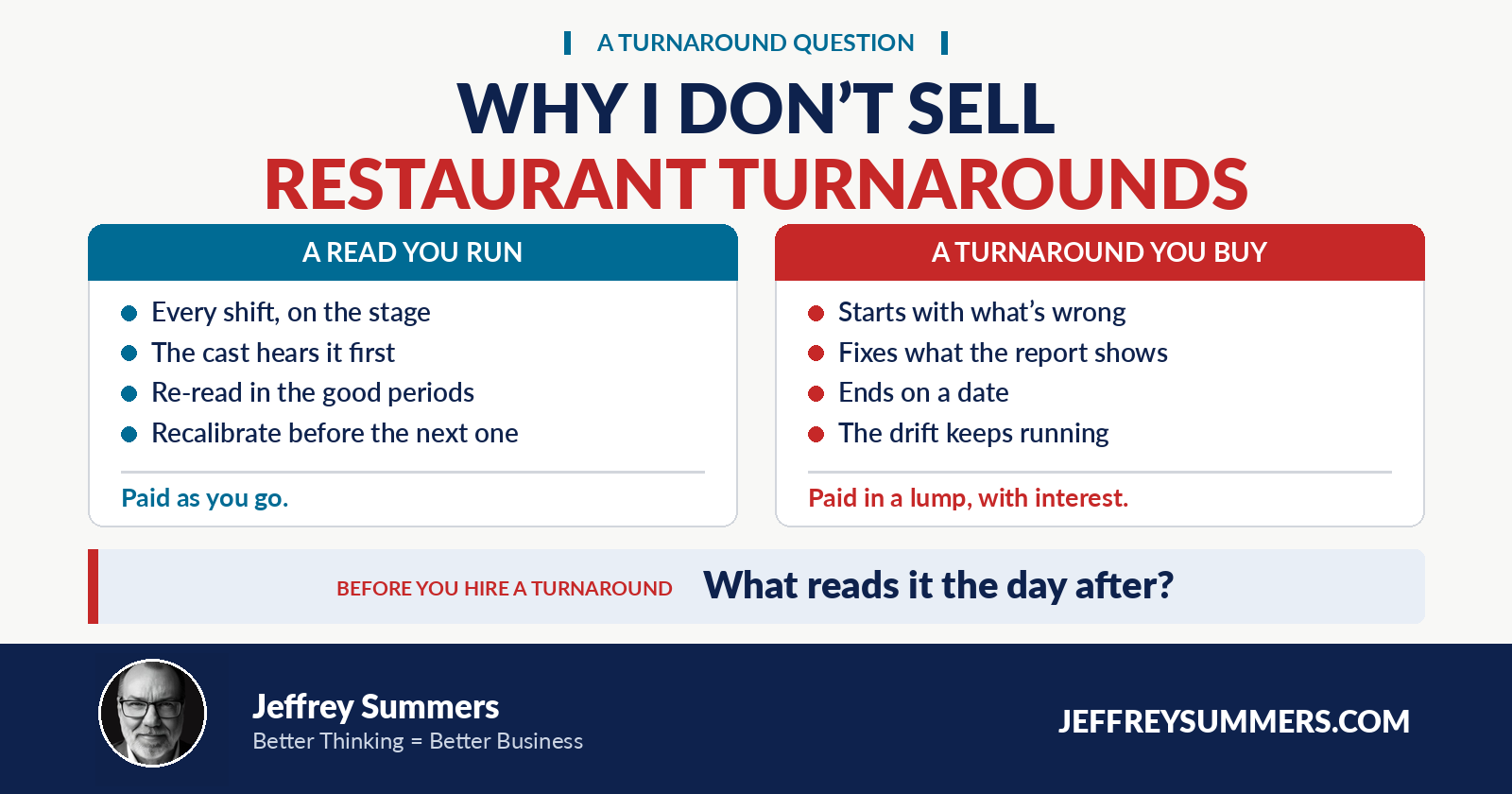
I don’t sell restaurant turnarounds, because a turnaround is the bill for a read nobody ran, and the only thing worth paying me for is the capability to run that read yourself, every shift, so the bill never piles up.
The chains are showing you what the other option costs. Wendy’s is on its second turnaround plan in a year. KFC brought Colonel Sanders back in 2015, rode him to thirteen straight quarters of growth, and brought him back again in 2025 after seven straight quarters of decline. Del Taco’s new owner launched a turnaround whose first move was bringing back the original burrito, after Guest complaints about two years of menu changes. The independent operator watches all of it and learns the wrong lesson: when the numbers slip, call someone for a turnaround. That call buys a reset, paid in a lump, and leaves the operation reading itself exactly the way it did before. What I sell instead runs longer and gets paid for as it goes. I run the read with you until you, your leads and your cast run it without me. What it costs my practice is the call that opens with “I need a turnaround,” unless the operator is willing to start somewhere else.
The Same Comeback, Twice
I’ve been in the restaurant business for 45 years. That is long enough to watch the same brand run the same comeback twice, and KFC did it inside ten years.
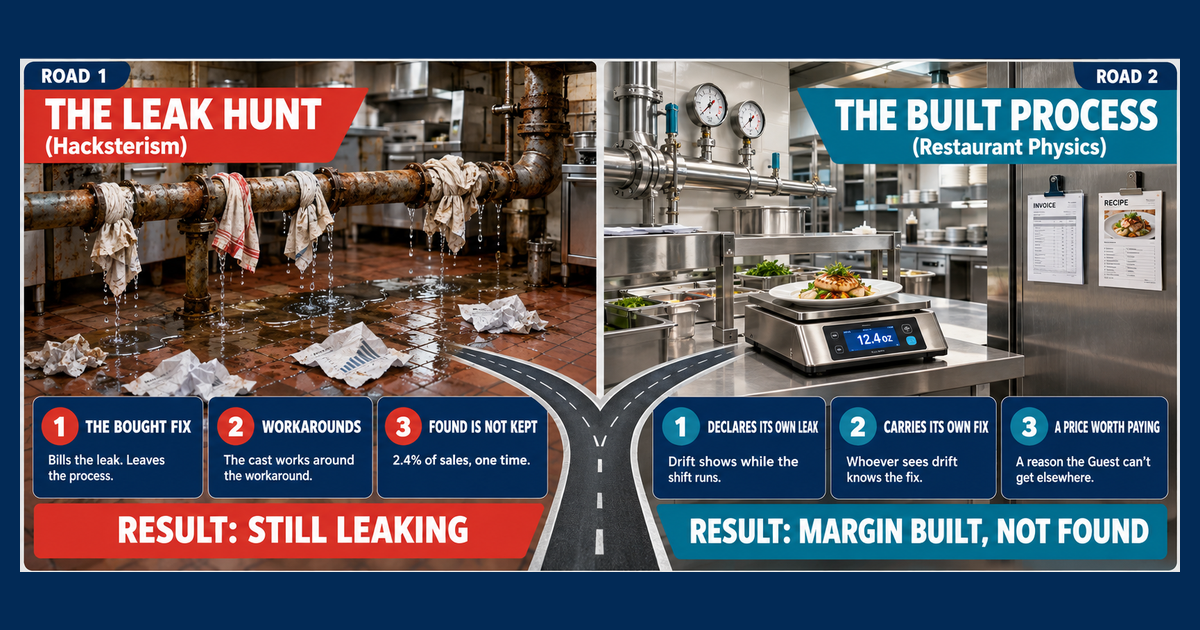
The first comeback worked. It worked because, for a while, the brand was reading what its Guests came for, and the numbers followed. Then the reading stopped while the numbers were still good, the drift came back, and the brand needed the same comeback again. In the Hacksterism piece I called that the turnaround that needs a turnaround. In the Restaurant Physics piece I laid out the architecture that prevents it: a read with no launch date.
Del Taco shows the other half. The information that drove its turnaround was never missing. It came from the Guests eating the burrito, the whole time the menu was drifting away from what they had come for. Nobody running the chain took that read in time, so the correction waited for a sale.
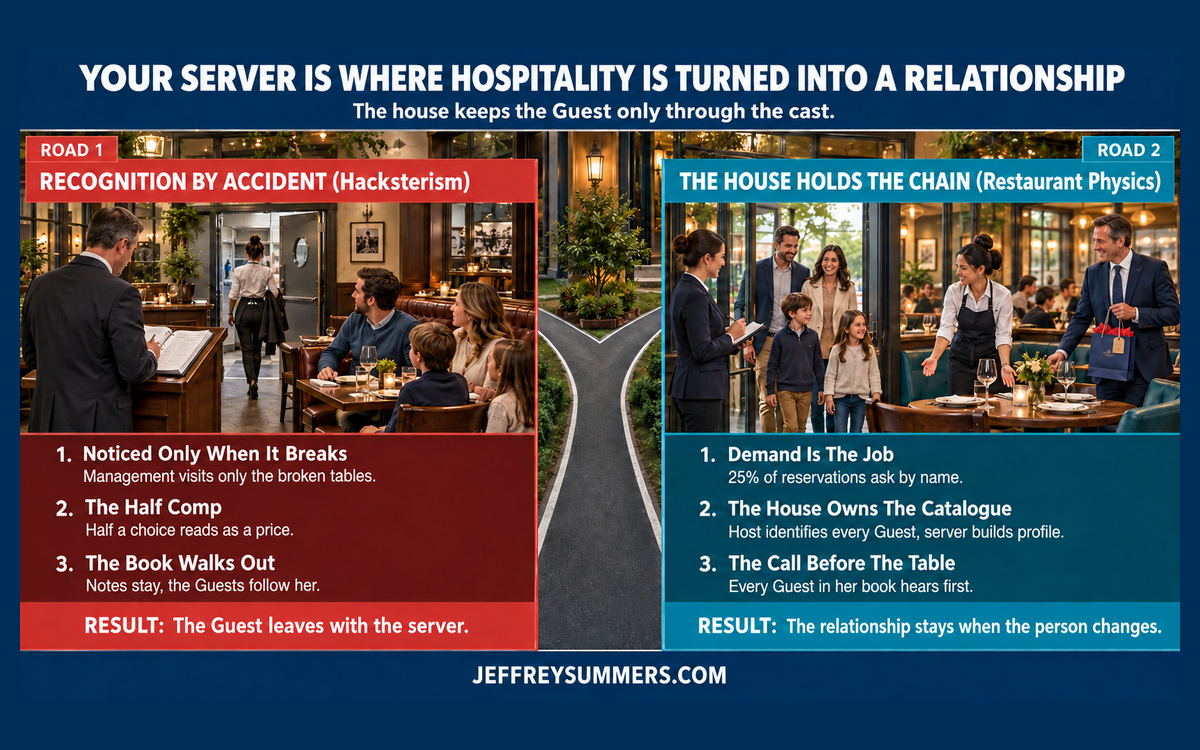
Neither failure needed a consultant to diagnose it. Both needed someone in the building reading the Guest every shift and someone deciding what the read meant. That is the work, and it can’t be done in a lump.
What A Turnaround Engagement Sells
A turnaround engagement is built as a timed contract. It has a start, a plan, a set of deliverables and an end date. It usually starts with what’s wrong: sales are down, labor is up, reviews are slipping. It ends when the numbers recover, or when the money runs out.
Read that shape against what actually happened to the operation. In my framework, [Contract Drift] is the gap between the terms a relationship was agreed on and the terms actually running in it. Every relationship you run drifts, with your Guests, your cast, your vendors and your market, all the time. The turnaround engagement arrives after the drift has grown large enough to show up in the report, fixes the position the report shows, and leaves on a date. The drift keeps running the day after it leaves, and nobody is reading it.
Most of what gets fixed is [Repair Work]: the operation returned to a state it was already in. Sometimes that’s exactly what’s needed. But a repair bought in a lump, with nothing left behind to read the next drift, is a repair you will buy again. That is why I don’t do timed contracts, and why I wrote that there is no turnaround package here and no rebrand track. One sequence runs, and it doesn’t get renamed to match what you walked in believing.
What You Buy Instead
You buy a read that runs without me. We build it across the same Fundamentals that produced the drift.
Perspective comes first, and it doesn’t start with what’s wrong. It starts with what your operation is for: who it’s for, what they value and what experience wins with them. Then we read your Guests before we read your report. [Primary Read] is the principle that the live read of the operation comes before the report, because the report is late by definition. A sales line can stay green while Guests leave, as long as the check rises faster than the Guest count falls. Wendy’s second quarter had check up 5.6% and traffic down 12.5%. We read the stage first and use the report to confirm what the stage showed or catch what it missed.
Product is where we read the Guest contract against the plate. Every portion trimmed for food cost, every simplified prep and every slow favorite pulled is a defensible decision that moves the running terms away from the agreed terms. We catch that at the size of one plate, decide that week whether it stays or reverses, and keep enough room to ask whether the thing should be rebuilt rather than repaired.
People is where the read becomes yours. The cast nearest the Guest hears the drift first. We design the read into their roles: one question in the pre-shift, the answer in the post-shift, the lead collecting it and you deciding what it means. Every contract gets a named owner and a cadence. Before any decision that changes a contract ships, we run [Full Consequence Read] on it: what it does to every actor it touches, in this period and the ones after it, and what it forecloses for each of them. A menu change read that way is one nobody has to reverse two years later.
Performance is where the read either keeps running or quietly stops. The danger is a good year. The numbers are up, the pre-shift question gets skipped, the post-shift log gets thin, and the review becomes a look at the report. [No Static Achievement] is why that costs you: nothing accumulated in the operation can be held without continuing to earn it. So the re-read is scheduled. It runs in a strong period the same as in a weak one, and every period we compare what the read said against what the report showed, and recalibrate where the report found something first.
All of it runs on [Operating Helix]: read, design, execute, re-read, recalibrate, then read again from a higher position than the last turn left you in. A turnaround is a circle. It brings you back to where you were. The helix brings you back to the same position one level higher, every turn.
When I’m Done
I stay with each capability until it’s ingrained, deep enough that you run it under pressure without me. Then we move to the next one. That’s the opposite of a turnaround engagement, which ends on a date whether or not anything was left behind.
[Constant Expiry] is the reason the capability is the only thing worth buying. What you know about your Guests starts expiring the moment you know it, because the conditions it was read against never stop moving. Any read I hand you is stale within a period. A read your leads run every shift stays current, because it’s always being taken again.
Three Questions Before You Hire Anyone For A Turnaround
Does the engagement end on a date? Read: if it does, ask what will be reading your operation the day after.
Does it start with what’s wrong, or with what your operation is for? Read: if it starts with what’s wrong, it’s going to fix the position the report shows and leave the cause where it was.
Does it leave behind a read your lead runs without the consultant in the room? Read: if you can’t name the person who will run it and how often, you’re buying the next turnaround along with this one.
Three good answers and you’re buying a capability, whether it comes from me or not. One or two and you’re buying part of a read. None and you’re buying a lump.
The Bill Either Way
You pay for the read either way. Profit holds no decisions. It reads what Perspective, Product, People and Performance decided or left running unread, and whatever isn’t good enough there sends you back to the Fundamental that produced it. Pay for the read shift by shift, in attention, and the scorecard shows it as what never appears there: no lump, no batch of closures, no favorite brought back after two years of complaints. Skip it, and you pay later, all at once, with interest, to whoever sells the turnaround. That’s why I don’t sell turnarounds. I sell the read that makes them unnecessary.
What You Do Monday Morning
Write down the last date anyone read your Guests on purpose. That means a question asked, an answer written down and a decision made from it, not a glance at the report. Then write down who did it. If the date is more than a week old, or the only name is yours, start Monday night: one question in the pre-shift, the answer written down in the post-shift, and you reading it Tuesday morning before you open the numbers.
Digging Deeper
Positions on the record:
The Turnaround That Needs A Turnaround
The Read That Never Needs A Launch Date
You Keep Buying The Same Process Under Different Names
Why I Don’t Do Timed Contracts
Why Most Restaurant Consulting Makes It Worse
Are You Growing? Why Operators Need A Restaurant Business Coach
Terms used in this piece: Operating Helix, Contract Drift, Constant Expiry, Full Consequence Read, Primary Read, Repair Work, No Static Achievement. Definitions in the Knowledge Base.
Discover more from Jeffrey Summers
Subscribe to get the latest posts sent to your email.