Everybody wants to know why restaurants fail. I get asked it more than any other question in my work, and the industry has its answer ready before the question finishes. Undercapitalization. Bad location. Competition. Thin margins. Labor. The economy. Timing. Rent.
Every item on that list is real. I have watched all of them do damage in real operations. And not one of them explains why two restaurants on the same block, at the same price band, in the same year, under the same cost pressure, staffed out of the same labor pool, produce opposite outcomes. A list of conditions cannot explain a difference in results when the conditions are held constant.
Restaurants don’t fail. Operators do. And only for one reason — they never learned what real growth is.
That is the whole argument, and the rest of this piece is the argument taken apart: why the standard list survives despite explaining nothing, what the definition failure actually is, the first cause sitting underneath it, the objections an operator raises against all of it and what happens to those objections at the mechanism level, and a diagnostic you can run against your own operation this week. Forty-five years in this business have not turned up a case that needs a different first cause.
Why That Is Not A Word Game
If the restaurant failed, the causes are conditions. Conditions live outside you. You respond to them, you survive them, you get lucky or you do not, and the work sits in the market, the lease, the vendor terms, the labor pool.
If the operator failed, the cause is a decision. Decisions live inside you. They can be examined, named, and made differently starting tomorrow, and the work sits in the read that produced the decision.
Same closed restaurant. Two diagnoses, two places to intervene, and only one of them contains a lever you still hold.
The distinction is not rhetorical, and here is how to test that. Take any condition on the industry’s list and ask whether the operation next door faced it too. Rent went up on both. The labor pool thinned for both. The delivery platforms took their cut from both. Competition arrived for both. If the condition is present in the survivor and the casualty alike, the condition is context, not cause. It is the terrain the architecture had to hold up in.
Undercapitalization deserves its own sentence, because it is the one that looks most like a genuine cause. Being underfunded is real and it kills operations. But undercapitalization is almost always a downstream number. It is what a plan that assumed the wrong things looks like eighteen months in — the volume that never materialized because the reason to return was never built, the margin that never held because the price was never made legible, the labor line that never came down because the operation kept paying to replace people. Money runs out for reasons. The reasons are the cause and the empty account is the record of them.
That is why I do not consult with restaurants. I consult with operators. Not as a positioning line, but as the only conclusion the argument leaves standing.
Why The Standard List Survives
An explanation that explains nothing does not last for decades by accident. It lasts because it does work for the people repeating it, and it is worth being honest about what that work is.
It is exculpatory. Every item on the list sits outside the operator. Not one requires him to examine a decision he made. Of all the available diagnoses in this business, the standard list is the only one that puts nothing of his on the table, and that is precisely why it is the most repeated one.
It is socially confirmed. He says it at the association meeting and eleven other operators nod. That nod feels like corroboration. It is not. It is eleven people running the same architecture reporting the same output, which is exactly what you would expect if the architecture, rather than the conditions, were producing the result.
It is partly true at the surface, which is the most dangerous kind of wrong. Nobody is disputing that rent is high or that margins are thin. The error is not in noticing the weather. The error is promoting weather to cause in a comparison where the weather is identical for everyone being compared.
And it is protected by survivorship. The operations that made it are read as having had better conditions, when in most cases they had the same conditions and a different architecture. Nobody writes up the survivor’s decision history, because a restaurant that is still open is not a story.
I am hard on the list because it is not harmless. An operator who believes it spends his money on conditions he does not control and his attention on a market that owes him nothing, for years, while the actual mechanism runs untouched in his own building.
It Is A Definition Failure, Not A Skill Failure
The operators I work with are not short on capability. They can move sales, cut cost, engineer a menu, fill a soft daypart, tighten a schedule, open a second unit, hold a standard.
They were taught that all of that is growth. It isn’t. It is transaction growth, which is real, measurable, and a different thing.
Growth is the increase in what the operation is capable of creating. Accumulation is the increase in what it possesses. Accumulation is additive and needs a rising dose to hold the ground it already has. Stop feeding it and it gives the ground back.
Watch what that dose requirement does over a few years, because this is the part operators feel before they can name it. The discount that filled a Tuesday has to be repeated to fill the next one, and repeated at a deeper cut once the Guest has learned the pattern. The promotion that lifted a quarter has to be topped by the next promotion. The labor cut that protected the month has to be followed by another, because the first one removed capability rather than waste. Every accumulation move borrows from the next period and charges interest in the form of a larger required dose. That is why the operator who is winning on every transactional metric can watch the operation get harder to run every year and have no vocabulary for what he is watching.
Capability does the opposite. A cast member who can now handle a difficult table without a lead does not need to be re-taught next quarter. A menu the kitchen can actually execute at volume does not need a new dose. A Guest who returns because of what the room is holds without a discount attached. Capability compounds without a rising input, which is the entire operational difference between the two, and the reason the word matters more than any other word in this business.
An operator can be world-class at transaction growth for a decade and never produce a single unit of growth. Which is why I do not start an engagement by asking what someone wants to grow. I ask what they think growth is.
The answer to that question predicts nearly everything downstream of it — how he reads a P&L, how he prices, whether the second location is a good idea, whether anyone on his current schedule will be there in a year. One question, diagnostic on all five fundamentals at once.
Chase More Or Build Better
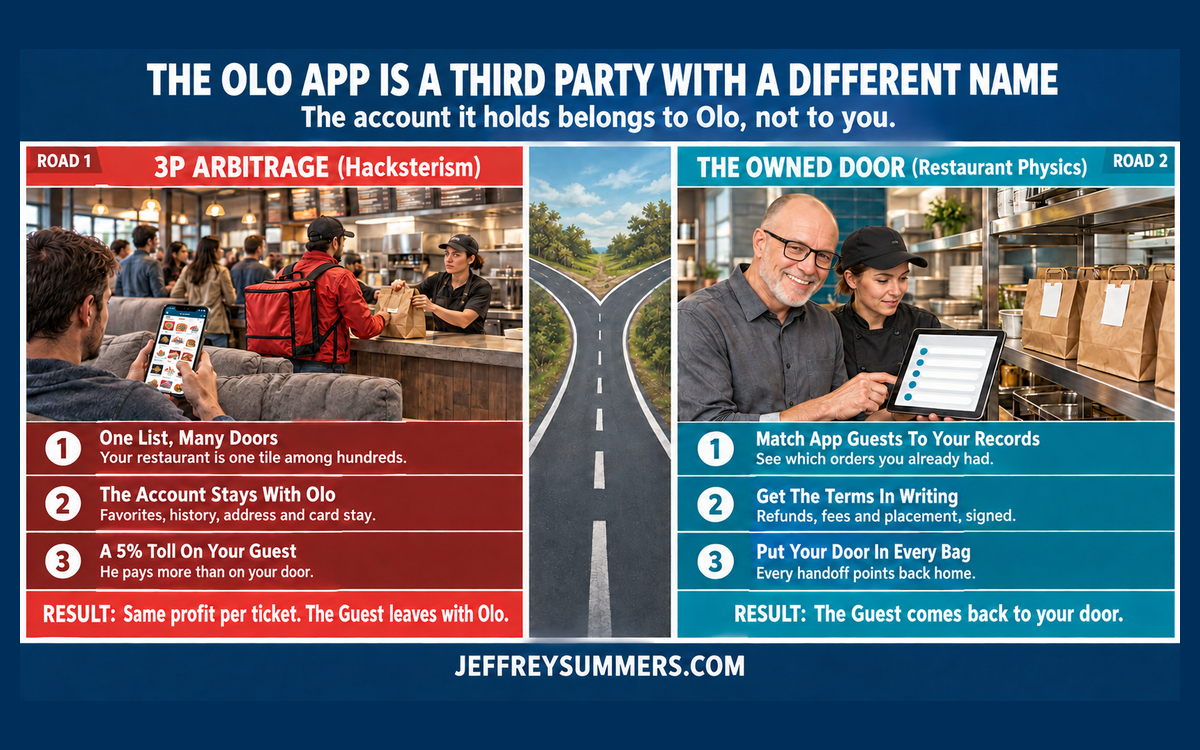
Road 1 chases more. Road 2 builds better.
Watch it on a slow Tuesday. Road 1 says get people in, run a discount, push the app, script the upsell, cut two hours, turn the tables faster. Road 2 asks why the right Guest would come back on a Tuesday, whether the cast can deliver that promise with what they have, whether the price still makes sense against the experience.
Road 1 tries to force the result. Road 2 fixes the reason.
The objection here is immediate and fair: the Tuesday is slow now, and building better takes time the operation does not have. That objection is correct about the timeline and wrong about the conclusion. Nobody is arguing against filling the Tuesday. The argument is about what the operation learns from having filled it. A discount that fills a Tuesday teaches the Guest that Tuesday has a price, teaches the cast that the room fills through incentive rather than through what they produce, and teaches the operator nothing at all about why the Tuesday was empty. The same Tuesday filled by a reason to come back leaves capability in the building. Both fill the room. Only one of them makes the next Tuesday easier.
You can chase more without building better. You cannot keep getting more unless you build better first.
I say building rather than getting on purpose. Getting better sounds personal, subjective, or accidental. Building better puts the operator where he belongs, as the architect.
The Transaction Is The Record, Not The Work
Underneath the definition failure is the first cause, and this is bedrock.
The operator mistakes the transaction for the thing that produces the outcome.
The transaction records what happened. A sale, a tip, a labor hour, a reservation, a review, a repeat visit, a resignation, a referral, a variance. Every one is a mark made after the fact. The social engagement produces what happens: whether the Guest felt seen or processed, whether the price read as fair or extractive, whether the cast member had the clarity, tools, trust, and authority to solve something.
The number comes last. The engagement comes first.
The check pays the bills. It does not make the Guest come in, trust the price, forgive a mistake, return next week, or bring anyone with him. It does not make a cast member care, stay, use judgment, or protect the room. The transaction proves value was exchanged. It does not create the conditions that make the next exchange possible.
This is where the reporting lag does its real damage, and it is structural rather than anybody’s fault. By the time the P&L shows you food cost, the shifts that produced it are over. Every profit metric you have is a record of decisions already made under conditions that have already changed. That does not make the numbers useless — they are strategic, and they should decide next period’s mix, where you invest, what you cut, which vendor gets renegotiated, which daypart gets killed. What they cannot do is tell you what to do tonight. An operator who runs tonight off last month’s numbers is steering by the wake.
So the operation ends up managed entirely at the layer where nothing is produced, by a person reading marks made after the fact, who then concludes the problem is the marks. That is the first cause running at full strength, and it looks like diligence the whole time.
That is why I do not open an engagement with the numbers, the menu, or the labor model. I open with the read that produced them.
Not Knowing You Chose Is Still Choosing
Most operators did not pick Road 1. They inherited it from the trade press, the vendor deck, the franchise manual, the last operator they worked for, and the ambient common sense of this industry. It never presented itself as a choice because it arrived as the water.
They chose anyway. By design or by default, the architecture got built and it produced its outcomes.
The objection is that this is unfair, and I want to answer it rather than wave it off, because the operator raising it is not being defensive. He genuinely did not know there was a fork. Fairness, though, is a question about blame, and blame is not what is being assigned here. Causation is. The architecture does not check whether you understood the decision before it produces the outcome, any more than a load-bearing wall checks whether you knew it was load-bearing. Naming the default as a choice is not an accusation. It is the only move that puts the thing back in your hands, because a condition you inherited but can now see is a condition you can change, and one you cannot see is not.
And design is a separate question from road. An operator can deliberately build Road 1 with total intention — more capture, more control, more volume — and that is a designed Road 1, still Road 1. The Summers Principle adjudicates whether the outcome was chosen or allowed. Two Roads adjudicates what the architecture was built to produce. Both questions get asked, in that order, in every engagement I take.
That produces four operations, not two. Designed Road 1 is coherent, effective within its terms, and honest about what it is; it is the strongest thing on Road 1 and it is still consuming the asset it depends on. Default Road 1 is the industry’s most common operation and the one that produces most of the obituaries. Designed Road 2 is the work. Default Road 2 is the operator with good instincts and no architecture, who produces relational moments he cannot repeat, cannot teach, and cannot defend when pressure arrives.
Wrong Architecture, Not Poor Architecture
These operations do not fail because they are badly built. A wrong architecture can be exceptionally well designed — coherent, disciplined, scalable, documented, competently executed. Its failure is not quality. It is fit.
So the operating test is not whether your architecture works as designed. It is what your architecture requires people to suppress, distort, or work around in order to work at all. When the answer is their judgment, their dignity, their need for context, or their ordinary human variability, the architecture is sound on its own terms and wrong for the people required to run it.
You can find this in an afternoon without any help from me. Walk the operation and look for the workarounds — the laminated card nobody follows, the sequence everybody does in a different order than the manual, the thing the closing cast member does every night that appears in no document, the exception the lead grants so routinely it has become the rule. Each of those is a place where a human being is quietly repairing the architecture at their own expense so the operation can function. Operators typically read workarounds as discipline problems and try to enforce them out of existence. They are diagnostic data, and enforcement destroys the repair while leaving the fault.
An architecture that ignores how people actually behave is not sound architecture. It is organized wishful thinking.
That is the question I ask before I look at a single system you already have.
Competence Is An Accelerant, Not A Correction
Your strengths go to work on behalf of the error. Talent solves a problem that was never the constraint. Strategy allocates against a false picture. Execution accelerates in a direction nobody picked. Every improvement makes the wrong architecture more complete.
Which is why the hardest-working operator inside the wrong architecture fails faster than the lazy one beside him. The lazy operator’s incompetence functions accidentally as a brake. He never fully implements the thing that is hurting him. The disciplined one implements it completely, on schedule, across every station, and arrives at the destination the architecture was always pointed at, sooner and in better order.
That indicts most of what my own industry sells. Systems, standards, scorecards, dashboards, playbooks, training modules, technology stacks. All real work. All accelerant when installed into an architecture nobody chose.
So I gate execution work behind the architectural question, which means I will sometimes refuse to sell you the thing you called me to buy. That refusal costs me engagements and I am not going to pretend otherwise. Selling the system somebody already decided he wants is the easiest revenue in this trade, and it is easy precisely because it requires no examination from either party.
All Road 1 Strategy Is Arbitrage
Arbitrage is not one Road 1 mechanism among many. It is what Road 1 is.
People arrive carrying trust, attention, identity, judgment, cooperation, and loyalty. The architecture converts those into conversion, retention, efficiency, compliance, data, and margin. The gap between what they bring and what comes back is the position, and the spread is the profit.
The problem is not that the operation earns a return. Any operation has to. The problem is whether it creates enough reciprocal value to justify what it captures, and Road 1 routinely monetizes social capital it did not create and does not replenish.
This is the mechanism that makes the timeline so confusing from inside. Depletion does not show up as depletion. It shows up as a great quarter, because the period in which you draw down an asset looks identical on a P&L to the period in which you earn one. The Guest goodwill that absorbs a service failure without a complaint took years to build and shows up nowhere on a statement, so spending it registers as an unusually smooth month. The cast member’s discretionary effort — everything they do that nobody asked for — is free labor with no line item, so consuming it looks like productivity. The operation runs on a reserve nobody is measuring, and the depletion is only legible on the day the reserve is empty, at which point the operator experiences it as a sudden inexplicable collapse of things that used to work.
Prime cost improves while the asset depletes. Road 1 scales exchange while underdesigning relationship, and eventually discovers that the relationship was the infrastructure all along.
So the second read I run is direction: whether Guest trust, cast agency, candor, and willingness to participate are being built or consumed.
Relationship Language Is Not Relationship
Transactions are not manipulation. Buying a meal, booking a table, paying a consultant — legitimate exchanges, all of them.
The manipulation is presenting a transaction engine as a relationship while concealing or subordinating the transactional objective. It borrows the emotional authority of real human connection without accepting the obligations of one: honesty, reciprocity, care for the other party’s interest, consent, and the freedom to decline without penalty.
Which is why a practice does not qualify as Road 2 because it feels compassionate, has a pleasant culture, or uses the word community. It qualifies if it creates visible reciprocal value, if the exchange is transparent and freely chosen, if it increases rather than depletes trust and agency, and if it makes the operation more capable of holding its promise without greater extraction. Anything less is softer Road 1 in better language.
The freedom-to-decline test does more work than the other three combined, and it is the one operators fail without noticing. Watch what happens in your operation when a Guest says no, or when a cast member declines an extra shift. If declining carries a cost — colder treatment, a worse section, a quiet mark against them, a program tier they silently drop out of — then the warmth was conditional on compliance, which means it was pricing, not relationship. Real reciprocity survives a no.
I run those four questions against anything anyone tells me is relational, including my own recommendations.
Coherence Beats Depth
Your operation does not run one architecture. It runs several at once and they have to agree. The contract form you run with Guests. Whether the operation produces Guests or Customers. Composition on the food side. The reward structure that pays your cast. Your own read and decision discipline.
Most operators who have done real design work still lose here. They design the contract as relational while the reward structure pays the cast for throughput. That is not partially designed. That is incoherent, and incoherence does not stabilize as a mixed system. It collapses toward whichever layer runs the cheapest, most default form, because default is cheaper than design under pressure.
The reward structure wins that collapse nearly every time, for a reason worth naming. It is the layer with a number attached, and the number gets read out loud at the end of every shift. Whatever you say your values are, the thing you measure and pay for is the operating instruction your cast actually receives. They are not being cynical when they follow the money. They are correctly reading the only unambiguous signal in the building.
You do not get to pick which layer wins. Then you read the outcome as market feedback and conclude that relational hospitality does not work here.
So I read the seams between your layers rather than the depth inside any one of them. Operations die at the seams, and the seams are invisible from inside a single layer.
Why You Cannot See This From Inside
The obvious objection to all of this is that an intelligent operator would notice. Most of them are intelligent. Most of them do not notice, and there is decent evidence about why.
The competence to evaluate a decision and the competence to make it are the same competence. When it is missing, the operator does not experience a gap — he experiences confidence, because the instrument that would detect the gap is the instrument that is absent. The operator running a Road 1 architecture is not ignoring the alternative. He cannot see that there is one to ignore. His read produces one shape of answer, and he experiences that shape as judgment rather than as a limit.
The second effect is subtler and it hits the operator with the clearest vision, not the murkiest. Once you know something, you cannot model not knowing it. There is a well-known study in which one group tapped out familiar songs and predicted listeners would identify about half of them; listeners got three out of a hundred and twenty. Tappers were hearing the melody in their heads. Listeners were hearing knocks. The operator with a clear picture of the experience he intends is hearing the melody. His cast, his Guests, and his numbers are getting knocks, and he cannot understand why nobody is picking up the tune he is so plainly playing.
Together those explain the durability of all this. The operator who cannot see the fork is confident, and the operator who can see it cannot understand why nobody else does. Neither one is being stupid, which is exactly why this survives in a room full of capable people.
Holding Is The Work
There is no Road 2 profit infrastructure. Every reporting cycle reads a relational operation as underperforming against transactional benchmarks. Every advisor, lender, and vendor in your orbit holds the transactional scorecard. The pressure to recalibrate back toward Road 1 arrives monthly, forever, no matter what you committed to.
Be specific about where that pressure comes from, because it is not a mood. The accounting format itself is transactional; there is no line on a standard P&L for capability built, trust accrued, or capability retained. The lender’s covenants are transactional. The broker’s valuation multiple is transactional. The vendor’s case study is transactional. The trade press’s benchmark tables are transactional. Every instrument in your orbit was built to measure accumulation, so a Road 2 operation reads as an underperforming Road 1 operation on every one of them, permanently, even while it is winning.
Architecture is not installed and then finished. It is held, against a current running the other way, and what gets held is held by a person.
That is the last reason the work is with the operator, and it is why the engagement ends with capability installed rather than with me on retainer. A consultant who has to stay built dependence instead of capacity, which is Road 1 run on the operator instead of the Guest.
Where This Runs Across The Operation
The definition failure is not a Perspective problem with consequences elsewhere. It runs on all five fundamentals, and an operator who addresses it in one place has addressed a fifth of it.
Perspective. Growth defined as accumulation, failure read as weather, and the transaction mistaken for the work. Nothing downstream can be right while these are wrong, which is why this is the layer I work first and the layer operators most want to skip.
Product. The GX gets treated as a set of features to add rather than a promise to hold. Additions accumulate — a new menu section, a new program, a new touchpoint — while the operation’s actual capability to deliver any of it consistently stays flat or degrades.
People. Cast are staffed as throughput capacity rather than developed as capability. The reward structure pays for coverage, so development loses to coverage every time it competes, and the operation runs in permanent replacement mode.
Performance. Execution on the stage is managed by enforcing standards rather than by building the capability the standards assume. Workarounds multiply, and the operator reads them as discipline problems.
Profit. Margin is defended by subtraction — cut, trim, discount, substitute — rather than produced by capability. Every subtraction removes a little more of what generated the margin, which requires a larger subtraction next period.
Five reads, one mechanism. That is what makes this architectural rather than departmental, and why handing it to a general manager as a project is the operator delegating his own Perspective.
The Diagnostic
Run these against your own operation. Each has a specific move and a plain read.
Test one — the definition test. Write your own definition of growth in one sentence, without using the words more, increase, or sales. If you cannot finish the sentence, you are running the industry’s definition regardless of what you believe about yourself.
Test two — the dose test. Take the three moves that most improved your numbers in the last year. For each, ask whether repeating it next year requires the same size move, a larger one, or none at all. Anything requiring a larger dose was accumulation, and you are already on the escalator.
Test three — the both-roads test. Take the decision sitting on Monday’s list and write both roads’ version of it in full. If the Road 2 version comes out vague where the Road 1 version comes out specific, your architecture supplies you one shape of answer and you have been calling that shape judgment.
Test four — the workaround test. Walk the operation and count the places where a person is quietly repairing the system so it can function. Every one marks a spot where the architecture is wrong for the people running it.
Test five — the seam test. Name what your Guest contract promises, then name what your reward structure pays for. If those two answers point in different directions, you have found the seam, and you already know which side will win under pressure.
Test six — the decline test. Identify what happens in your operation when a Guest or a cast member says no. If declining carries a cost, the relational layer is pricing in warmer language.
Test seven — the reserve test. Name the last three times something went wrong in front of a Guest and nobody complained. That was goodwill absorbing the failure. Ask what you did that month to put any of it back.
How the score sorts. Fail one or two and you have a specific repair with a clear address. Fail four or more and you are not looking at a set of problems, you are looking at a coherent architecture producing exactly what it was built to produce, and no individual fix will hold against it. Pass all seven and still be struggling, and the cause is genuinely a condition — which does happen, and which is worth knowing precisely because it is rare.
What You Do Monday Morning
Take the decision already sitting on Monday’s list. The one you were going to make without discussion. A price move on three items. A schedule that cuts a shift. A promotion for a soft daypart. A new standard for the stage.
Before you make it, write both roads’ version of that same decision, side by side, in full. Not the philosophy. The actual move. What changes on the menu. What changes on the schedule. What the Guest experiences. What the cast is asked to do. Both versions have to be specific enough to hand to someone and have them execute it.
Then read what you wrote. If the Road 2 version came out vague where the Road 1 version came out specific, you have your diagnostic: the architecture you have been building for years supplies you one shape, and you have been calling that shape judgment.
Run it on every decision of that class for two weeks and count how many times you could not produce the alternative. That count is the honest read on how much of your operation you chose and how much you inherited.
The Closer
The industry’s list of causes describes weather. Weather is real, and weather is what your architecture has to survive. But the question was never about the weather. It was about the building.
You chased more because you were taught that more was growth. It isn’t. Growth is what the operation becomes capable of creating, and that gets built or it doesn’t.
The restaurant gets the obituary. The restaurant never had a vote.
Digging Deeper
Every term used above is defined in my Knowledge Base: https://kb.jeffreysummers.com/
Terms used: Restaurant Failure, Restaurant Architecture, Transactional Architecture, Relational Architecture, Two Roads, The Summers Principle, Causal Read, The Lost Opportunity Tax, Static Decline, Hacksterism
The architecture taught in full, fundamental by fundamental: https://physics.jeffreysummers.com/
The Road 1 arbitrage prosecuted where it lives in the wild: https://hacksterism.jeffreysummers.com/
Discover more from Jeffrey Summers
Subscribe to get the latest posts sent to your email.