
Cheesecake Factory just posted the quarter the whole industry is trying to manufacture, and the reason it could is the one thing a turnaround cannot buy back: the operation never lost the Guest. Comparable sales up 15.2% with traffic up 9.5% on just 2.4% pricing, 940 basis points above the Black Box Casual Dining Index — while QSR and casual dining keep running the same turnaround circuit they have been running for a decade. The difference between that quarter and the endless turnaround circuit is not strategy. It is what the relationship is made of.
I ran the read against my framework the day the release crossed, because a quarter built like that one is a specimen, not a headline. What the read found is below. What the read costs my practice is the call that opens with “I need a turnaround,” from an operator whose operation has been telling him the truth for quarters.
The Quarter Nobody Read Correctly
Total revenues of $1.033 billion, a record, in what management called the company’s slowest quarter of the year. Restaurant-level margin of 18.7%, up 240 basis points year over year. Annualized unit volumes above $13.9 million, another record. And the comp itself, taken apart: 15.2% total, built from 2.4% pricing, 3.3% mix, and 9.5% traffic. Nearly two-thirds of the comp is Guest visits.
That arithmetic is the whole argument. A comp can be bought with price. It can be engineered with portion and check-average moves. Traffic is the number in a comp that measures whether the operation is earning the visit, and this comp is mostly traffic.
The market read the quarter as an earnings story — a beat, a margin story, an entry point. It read the numbers and missed the argument. The story is not the margin. It is what is absent from the quarter: a rescue.
What A Turnaround Actually Is
A turnaround is a public admission of quiet operational decline. It is a brand spending money to win back a Guest the operation already lost — the relaunch, the refresh, the repositioning, the ad blitz, the value platform. Every dollar of it buys back something that was given away. The endless turnaround circuit in QSR and casual dining is not a series of strategies. It is one long confession, renewed quarterly.
The chains supply the examples themselves. Wendy’s on its second turnaround plan in a year. KFC bringing the Colonel back in 2015, riding him to thirteen straight quarters of growth, and bringing him back again in 2025 after seven straight quarters of decline. Del Taco’s new owner launching a turnaround whose first move was bringing back the original burrito after two years of Guest complaints about menu changes. Each one is a brand paying full price, in public, for decline it could have read in its own building while the numbers were still good.
The Two Clocks
Here is the difference between the sectors, and it is not the food. It is the clock the decline runs on.
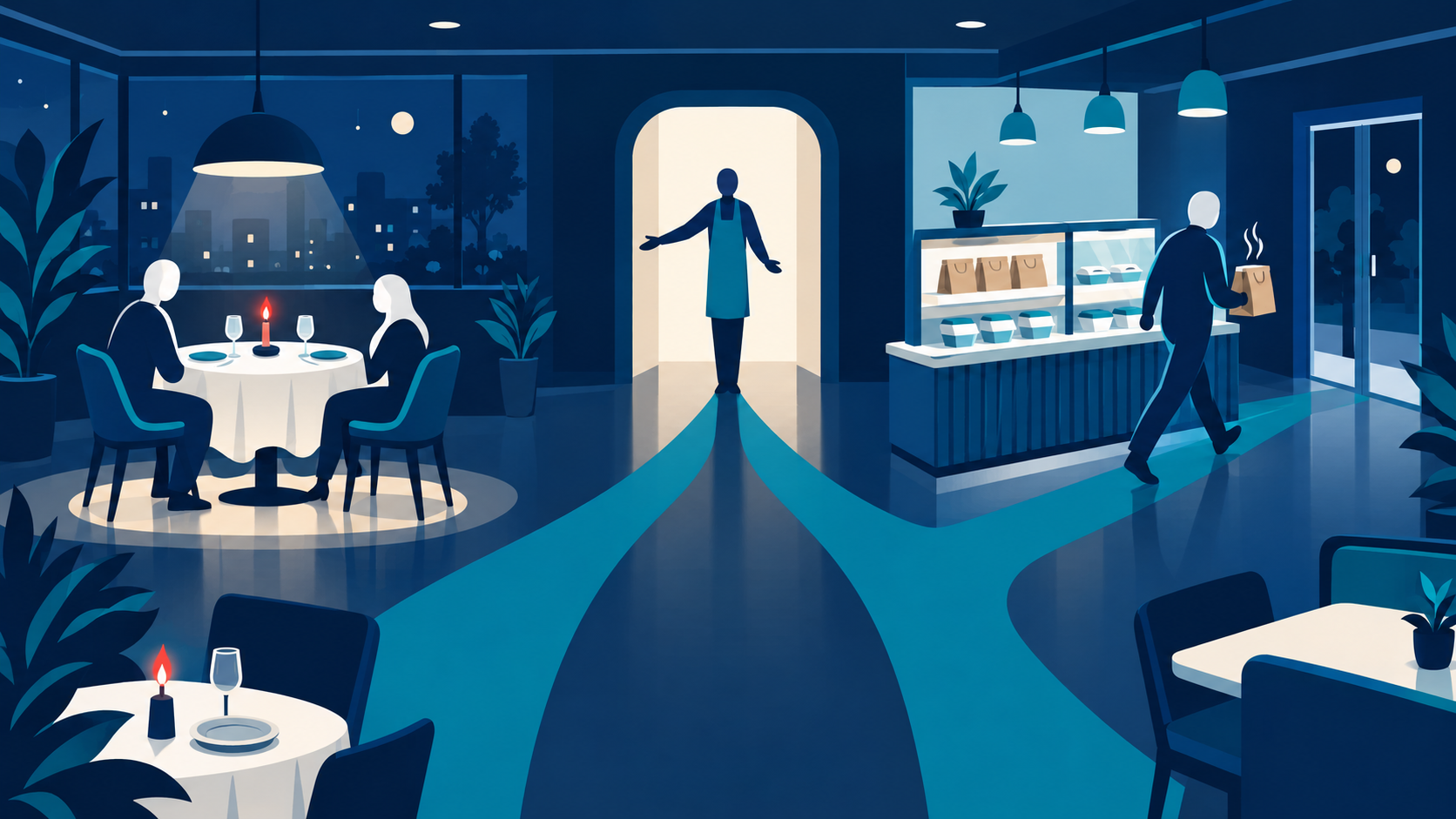
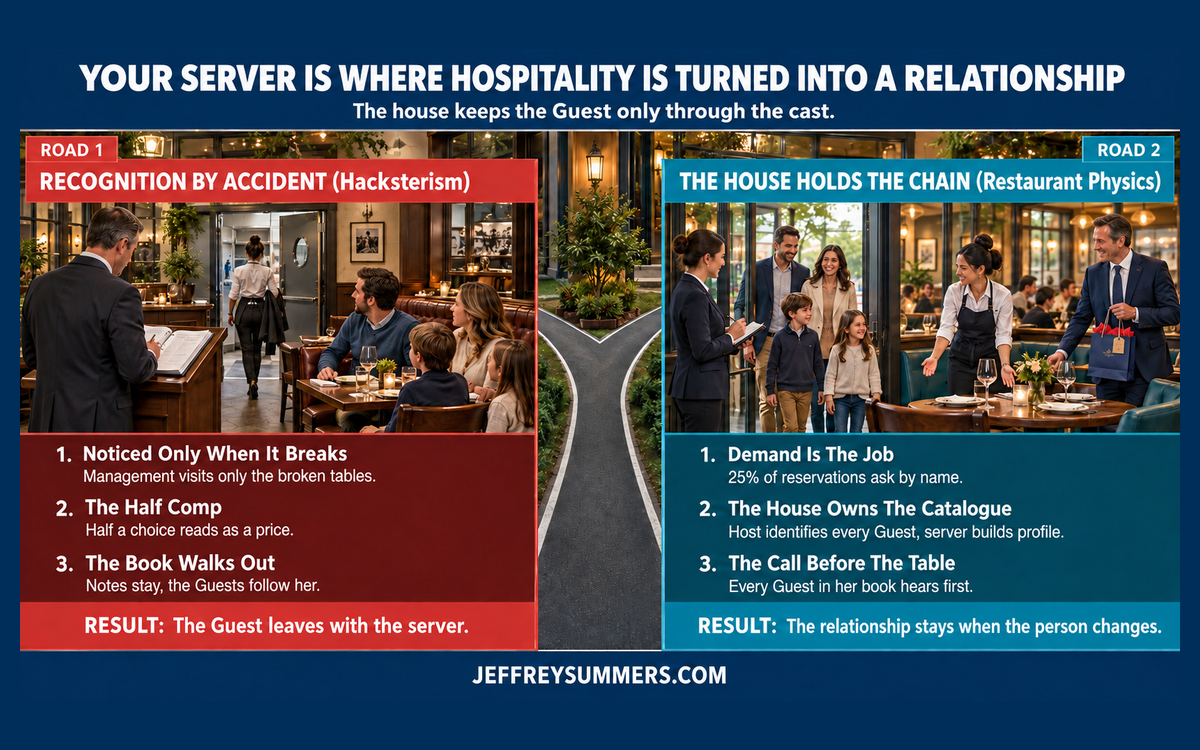
QSR is almost purely transactional. In my framework that is the first of [Two Roads], and the transactional road compresses the entire relationship into execution — speed, accuracy, consistency — because there is nothing else around the transaction to hold onto. The Guest’s entire experience of the brand is the ninety seconds that just happened. That compression has a consequence: when execution dips, traffic tells you immediately. No buffer, no lag, no forgiveness. It is why QSR chains tinker constantly, why their traffic swings are violent, and why their turnarounds cycle so fast — the feedback loop is honest, so the decline is visible, so the rescue gets called early and often.
Full-service casual dining runs the other road, and the other clock. The experience buffers the operation. The Guest forgives the slow plate, the wrong order, the off night — for a while. Traffic holds while decline accumulates underneath it. That is [Static Decline]: the operation getting worse invisibly, with the numbers still reading acceptable, until they do not. By the time traffic drops, the decline is years deep. The turnaround arrives as a rescue because the reckoning arrived late.
The cast carries the buffer. On the relational road, the same experience that forgives the operation’s bad nights is produced by a cast that stays long enough to know the Guests — and the company’s own attribution this quarter put best-in-class execution and industry-leading retention at the front of the list. On the transactional road, the cast executes the transaction; there is nothing in the role to absorb a mistake, only to avoid one, which is the People version of the same compression.
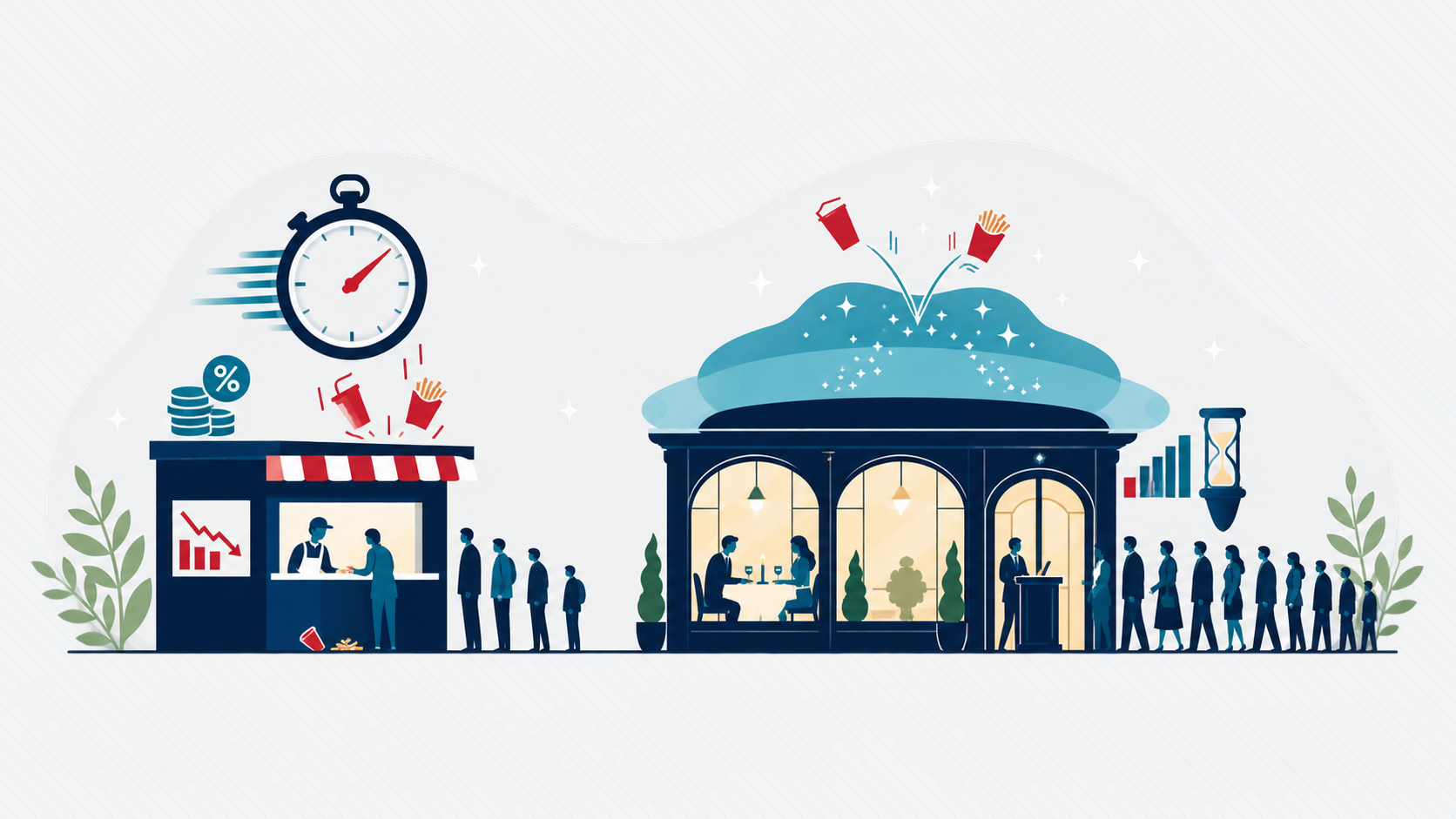
Same physics, opposite clocks. The transactional Guest has nothing to forgive with, so execution decline converts to traffic loss immediately. The relational Guest forgives for quarters, so the reckoning arrives years late. Neither clock changes the cost of the decline. Only the schedule.
The Value Menu Answers The Wrong Question
When a transactional brand sees traffic soften, the reflex is price. But discounts do not drive traffic — that is the [Discount Traffic Myth], and it is the single most expensive false belief in the industry. The apparent lift is deal-shoppers converting to the discount, not the brand. The reference price resets to the deal, and when the deal ends, the traffic ends with it. Every discount locks in the next one — [Transactional Contraction], compounding — because the reversal is not a lever anymore. It is a rebuilding project, and you have to defeat the expectations you trained the Guest to hold.
The value menu is an answer to an execution problem. The Guest did not leave because the price was too high. The Guest left because the operation got worse. Paying the Guest to tolerate a worse operation funds the very decline the discount was supposed to fix, and the comp it produces reads green the whole way down.
Cheesecake Factory ran the opposite arithmetic this quarter, whether anyone there framed it that way or not: modest pricing, real traffic. The comp was earned in visits, not bought in price — and that is the difference the value menu cannot produce.
The Rule
The operation is either the whole relationship or the thing the relationship forgives.
In the transactional business, the operation is the relationship — nothing else exists to absorb a mistake, so it is either excellent or declining, and the traffic tells you which every single day. In the relational business, the operation is the thing the relationship forgives — until it does not.
Cheesecake Factory never needed a turnaround because it never needed forgiving. Its traffic is up 9.5% because the operation kept earning the visit, and the comp is mostly people, not price. The scorecard agrees: margin of 18.7%, up 240 basis points, in the slowest quarter of the year. Profit did not get addressed in that release. It reported what Perspective, Product, People and Performance had already decided.
What You Do Monday Morning
Pull your last four periods of comps and split them into price, mix, and traffic. If the comp is mostly price, you are buying revenue, not earning it. Then run the forgiveness read: if your execution dropped one notch tomorrow, how fast would traffic tell you? If the answer is immediately, you have no buffer — your operation is the whole relationship, and it is either excellent or declining, so the read has to run every shift. If the answer is “I would not know for a year,” you have a buffer — and the buffer is hiding whatever is accumulating underneath it, so the read has to run underneath the numbers, where the numbers are still green.
Digging Deeper
Positions on the record:
The Turnaround That Needs A Turnaround
Why I Don’t Sell Restaurant Turnarounds
You Keep Buying The Same Process Under Different Names
Terms used in this piece: Two Roads, Static Decline, Transactional Contraction, Discount Traffic Myth. Definitions in the Knowledge Base.
Sources Cited In This Piece
The Cheesecake Factory Incorporated, third quarter fiscal 2026 earnings release, October 27, 2026 — comparable sales +15.2% at The Cheesecake Factory restaurants, total revenues $1,033.4 million, restaurant-level margin 18.7% — https://www.businesswire.com/news/home/20261027870083/en/
The Cheesecake Factory Q3 2026 earnings call, October 27, 2026 — traffic +9.5%, pricing 2.4%, mix +3.3%, Black Box Casual Dining Index outperformance of 940 basis points, annualized unit volumes above $13.9 million, restaurant-level margin up 240 basis points — https://stockanalysis.com/stocks/cake/transcripts/717302-q3-2026/
Discover more from Jeffrey Summers
Subscribe to get the latest posts sent to your email.