
I’ve recommended Olo’s ordering stack to clients for twenty years, and the Olo App put a conflict inside that recommendation, because the company I sent them to for their own door now runs a door of its own that competes with theirs for the same Guest.
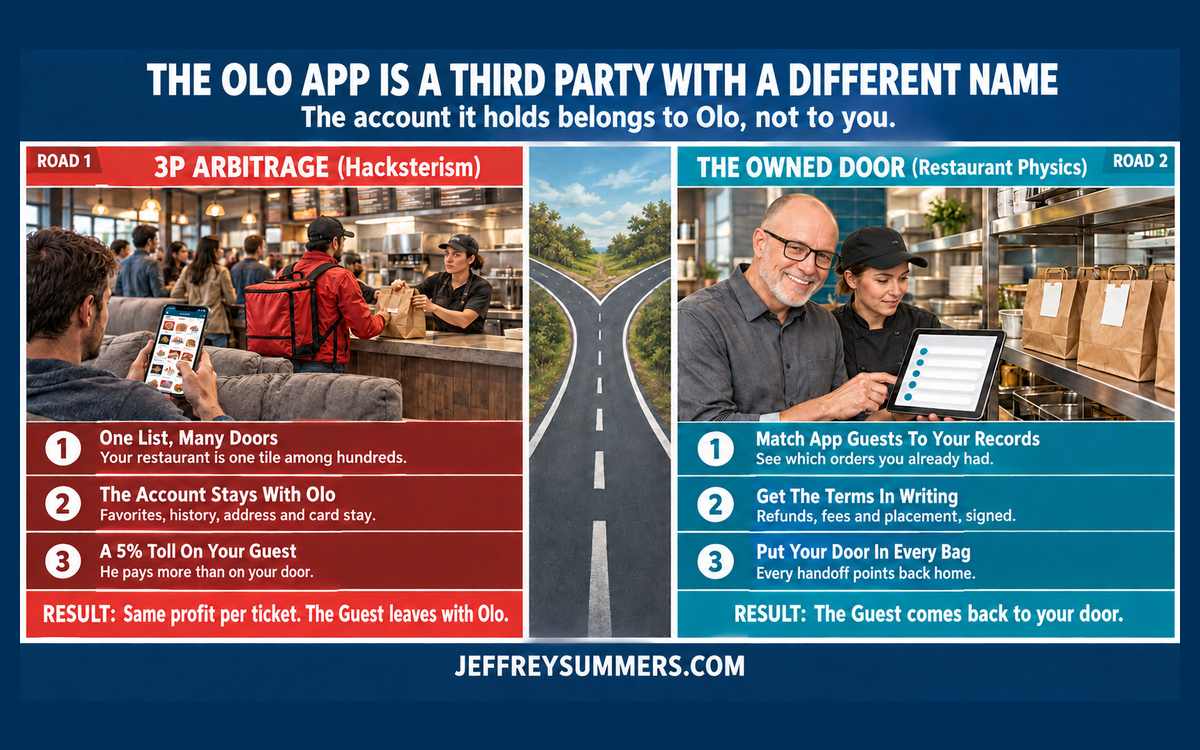
Olo builds the restaurant’s own ordering: the ordering on its website, its app, and the connection into its kitchen. The restaurant pays for it, the Guest orders on the restaurant’s door, and Olo is the plumbing. That’s why I recommended it. In October 2026 Olo opened the Olo App, a list of about 20,000 locations across 250 brands that use Olo, with plans to bring in more of its roughly 90,000 locations. The Guest signs into an Olo Account, picks a restaurant off the list and pays Olo a 5% network fee. The restaurant pays no commission. The stack is still the plumbing. The app is a door. It runs on every client who built his direct ordering on Olo, and it costs him the next order every time a Guest who already used his door learns to open Olo’s instead. What’s at stake for my practice is the recommendation itself. I sent clients to build a door, and the vendor building it now earns more on the same order when the Guest places it somewhere else.
Noah Glass Answered Me In His Own Words
When I wrote that the Olo App is the same door as Uber Eats and DoorDash, Noah Glass, Olo’s founder and CEO, answered me on LinkedIn. Here is what he said, and what each answer means for a client on the stack.
“We literally encourage guests to order direct to avoid the 5% Network Fee.” That’s advice to the Guest, and Olo is paid when he doesn’t take it. The fee is the reason the Guest should use the restaurant’s door. It is also Olo’s revenue on the app.
“If they DO order through the Olo App, the restaurant gets the same guest data and same profit as a direct order.” Same profit as a direct order means the app is no cheaper for my client than the door he already paid Olo to build. It saves him money on one Guest only, the one who would have ordered on DoorDash or Uber Eats. On the Guest who already orders direct, the restaurant makes the same, the Guest pays 5% more, and Olo collects the difference.
“That’s fundamentally different.” It’s different from DoorDash and Uber Eats on who pays the rent. It isn’t different on the question that decides my client’s next order: whose account the Guest opens to place it. That account is Olo’s. Glass’s own launch post says the Olo Account carries “your favorite brands, order history, delivery addresses, and payment details.” The restaurant gets the data from the order. Olo keeps the account the Guest orders from.
“That’s our core business. We’ve done it for two decades. You’re missing that the Olo App drives new guests to the direct channel via Olo Accounts.” I looked for the step that does it. There isn’t one in the product as Olo describes it. The fee makes the app cost the Guest more than the restaurant’s own door. That’s a price difference, not a handoff. The restaurant gets a copy of the order data after the order. A copy of the data isn’t the Guest.
I believe him on the core business. Restaurant Dive reported the same thing: first-party orders “comprise its core business.” That’s the conflict. The core business is my clients’ doors. The app is a door next to them, run by the same company, and paid more on the same order when the Guest uses it.
Olo Told My Clients Where Their Door Falls Short
Glass told Restaurant Dive who the app is for: “this big middle in the normal distribution curve of guests who aren’t quite loyal enough to a brand to download their app.” Read that from my client’s side. The app is built on the Guest his own door hasn’t given a reason to come back to. That’s the gap. Olo found it, built a vehicle for it, and put my client’s brand inside it as one tile on a list of hundreds.
That is [3P Arbitrage]: the vendor builds the vehicle the operator didn’t build and inserts itself between the operator and the Guest. The Guest doesn’t prefer the vendor. He prefers the vehicle. And the list is [Customer Architecture]. A Guest scrolling a list of brands is choosing the list, and the list produces Customers for whoever owns it.
The answer isn’t to argue with the list. It’s [Gap Arbitrage] from the operator’s side: the operator who reads the vehicle his Guest needs and builds it keeps the vehicle. Olo just told every client on its stack what that vehicle has to do. It has to be the better way to order from him.
The Operators Called It First-Party
BWG Global’s written summary of its October 21 restaurant delivery forum, with delivery and digital executives from full-service, fast-casual and QSR brands and franchise groups, called the app a “credible 1P alternative.” 1P means first-party. The operators were calling a door they don’t own their own.
It’s easy to see why. Glass told Restaurant Dive that an app order “looks exactly to the restaurant as if it came through that first-party ordering platform.” The ticket comes through the same pipe as a direct order, so it reads as direct in the reports. Same pipe isn’t the same door. The Guest never stood on the operator’s door. He stood on Olo’s, and paid Olo to stand there.
The same summary says adoption depends on the restaurant’s own marketing and awareness. An operator who promotes his listing on the app is spending his own marketing budget to put his own Guests on Olo’s list.
The same operators had already tested what that kind of demand is. They cut their delivery marketing from 5 to 6% of sales down to 3% for a set period, and their delivery business weakened every time. When they restored the spending, growth came back. Demand that stops when the spending stops was rented, and the rent is the ad budget. The summary also reports delivery growth still running above in-store growth. Read as an owner, that’s the rented channel growing faster than the one the restaurant owns.
My Recommendation Had A Date On It
I recommended the stack because the door was the client’s. The Guest ordered on the restaurant’s website or the restaurant’s app, the restaurant paid Olo for the plumbing, and nobody stood between the restaurant and the Guest. Every read has a date on it. Mine was dated before Olo had a door of its own.
The stack hasn’t changed. Olo’s position has. A vendor that only builds doors earns when the restaurant’s door works. A vendor that also runs a list earns on the Guest either way, and earns more when he orders on the list. That doesn’t make the plumbing bad. It means the company selling my client the plumbing now has a second product that competes with what the plumbing was bought for. The support is the stack. The competition is the app.
So the recommendation gets read again, the same way I’d read any other: by what it does to the Guest my client already has.
What I Tell Clients On The Stack Now
Read the app in your contract. Find the Olo App in your agreement with Olo. Then get six answers in writing: whether your brand is on the app by your choice, whether you can keep your locations off it, whether the 5% Guest fee and the zero commission are written into your contract, who pays the remake or refund on a bad app order, whether placement on the list will ever be sold, and what network-level data from your Guests is shared and with whom. Olo hasn’t answered the last four publicly. Your account manager can answer them for your contract.
Don’t spend a dollar sending Guests to the app. Every dollar of marketing goes to your own door. A dollar that promotes your tile on Olo’s list pays to move your Guests onto it.
Read every app order by the Guest who placed it. The reports won’t separate them, so you do. Match each app Guest against your own door’s records from before the launch. A match is an order you already had, now carrying Olo’s 5%. A Guest who is new to you, or came off DoorDash or Uber Eats, is the one the app is worth having for.
Give the Guest the reason Olo says he doesn’t have. Price your own door at what the food costs in your room. Make pickup on your door the cheapest way to get your food anywhere, and tell the Guest before he orders. Put your door on the bag. The build is in the Restaurant Physics piece.
Put your door in the hands of the person at the counter. App delivery orders still go out through Olo Dispatch, often with DoorDash and Uber Eats couriers, so they still come to your counter in the same rush. The person handing over the bag is the last one who touches the Guest on every door. She decides whether he leaves knowing yours is the better way to order. Design that handoff with her.
The Closer
Per ticket, the Olo App ties my client’s own door, and against DoorDash and Uber Eats it wins. Per Guest, it loses the one he already had. That Guest pays 5% more, learns to open Olo’s app, and the account that places his next order stays with Olo. My recommendation was never Olo. It was the client’s own door. The stack still builds it. The app competes with it. Your door is the only one that keeps the Guest, and that’s the door I sent my clients to build.
What You Do Monday Morning
Pull your agreement with Olo and find the Olo App in it. Then send your account manager the six questions above and ask for the answers in writing. In the same email, ask for last period’s Olo App orders by Guest, and match every one against your own door’s records from before the app launched. That count tells you whether the app is bringing you Guests or moving the ones you have.
Digging Deeper
Positions on the record:
- Your Door Is The Only One That Keeps The Guest: The Olo App, DoorDash And Uber Eats Want Him On Theirs — https://physics.jeffreysummers.com/your-door-is-the-only-one-that-keeps-the-guest-the-olo-app-doordash-and-uber-eats-want-him-on-theirs/
- The Olo App Is A Third Party With A Different Name — https://hacksterism.jeffreysummers.com/the-olo-app-is-a-third-party-with-a-different-name/
- Every Read You Own Has A Date On It — https://physics.jeffreysummers.com/every-read-you-own-has-a-date-on-it/
- Demand You Create Is The Only Demand You Own — https://physics.jeffreysummers.com/demand-you-create-is-the-only-demand-you-own/
Terms used in this piece: 3P Arbitrage, Customer Architecture, Gap Arbitrage. Definitions in the Knowledge Base.
Sources Cited In This Piece
- Noah Glass, LinkedIn replies to Jeffrey Summers on Ben Coley’s post, October 19, 2026 — “We literally encourage guests to order direct to avoid the 5% Network Fee”; “same guest data and same profit as a direct order”; “That’s fundamentally different”; “That’s our core business”; “We’ve done it for two decades”; “the Olo App drives new guests to the direct channel via Olo Accounts” — https://www.linkedin.com/feed/update/urn:li:activity:7518008659159838720/
- Noah Glass, LinkedIn, October 2026 — Olo Account carries “your favorite brands, order history, delivery addresses, and payment details” — https://www.linkedin.com/feed/update/urn:li:activity:7519005068302573568/
- Restaurant Dive, October 21, 2026 — about 20,000 locations across 250 brands, roughly 90,000 Olo locations; 5% network fee to the Guest; app orders look “exactly to the restaurant as if it came through that first-party ordering platform”; first-party orders “comprise its core business”; “this big middle … of guests who aren’t quite loyal enough to a brand to download their app”; Dispatch, couriers often DoorDash and Uber Eats drivers — https://www.restaurantdive.com/news/olo-app-delivery-commission-fees-aggregator-competition/833536/
- BWG Global, Restaurant Delivery Services Outlook forum summary, October 21, 2026 — “credible 1P alternative”; adoption depends on restaurant marketing and awareness; marketing cut from 5 to 6% of sales to 3% weakened delivery, restored spend reaccelerated it; delivery growth above in-store growth — https://bwgglobal.com/research/coverage/
Discover more from Jeffrey Summers
Subscribe to get the latest posts sent to your email.