
Why the honest no is marketing, the bad no is the only thing that trains a Guest to leave, and the recurring crash is architecture.
The stop-seating argument is the wrong argument. A kitchen that crashes at the same peak every weekend is an architecture that was never designed to hold that volume — and no decision made at the door, in either direction, fixes architecture.
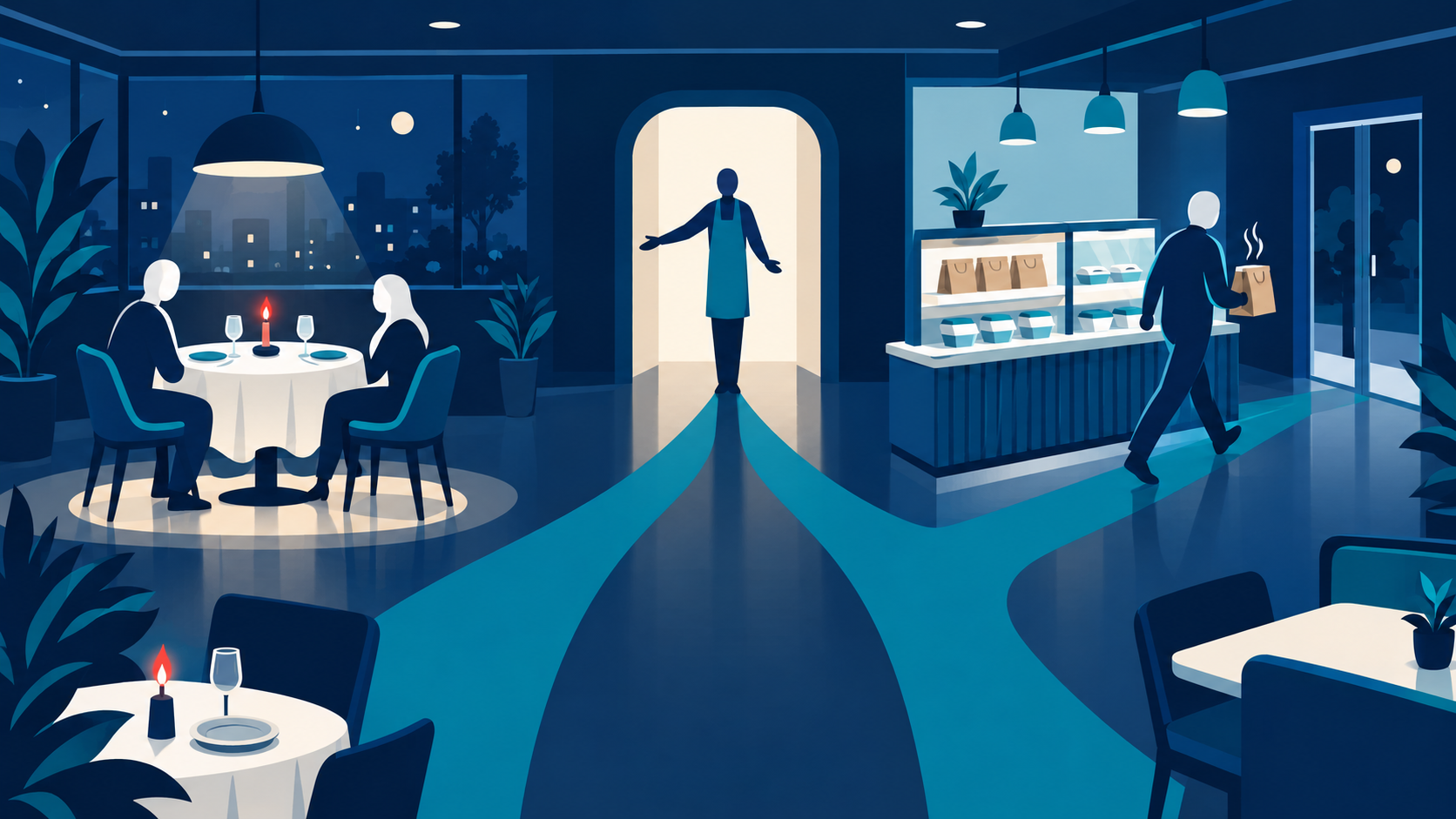
The mechanism under the whole debate is simple and mostly unspoken: the door is a filter and the table is a commitment. A Guest turned away at the door still has their evening — full information, their own decision, one lost cover. A Guest seated and then failed gave you their evening and got back a bad one — a broken promise, and broken promises are what kill return rate. What is actually at stake in every stop-the-seating argument is not whether to slow the door. It is whether the restaurant was ever built for the demand it runs on, and whether the person at the door tells the truth about it. That is the read this piece runs — against the most-shared essay on the question this week, Nathaniel Allen’s “Chef, I’m Not Stopping Seating,” which tells the story of a brunch service where the kitchen’s leader stopped seating, the pause cleared the rail, and the restart crashed everything again inside twenty minutes.
The Evidence: The Essay’s Own Story Convicts Its Own Thesis
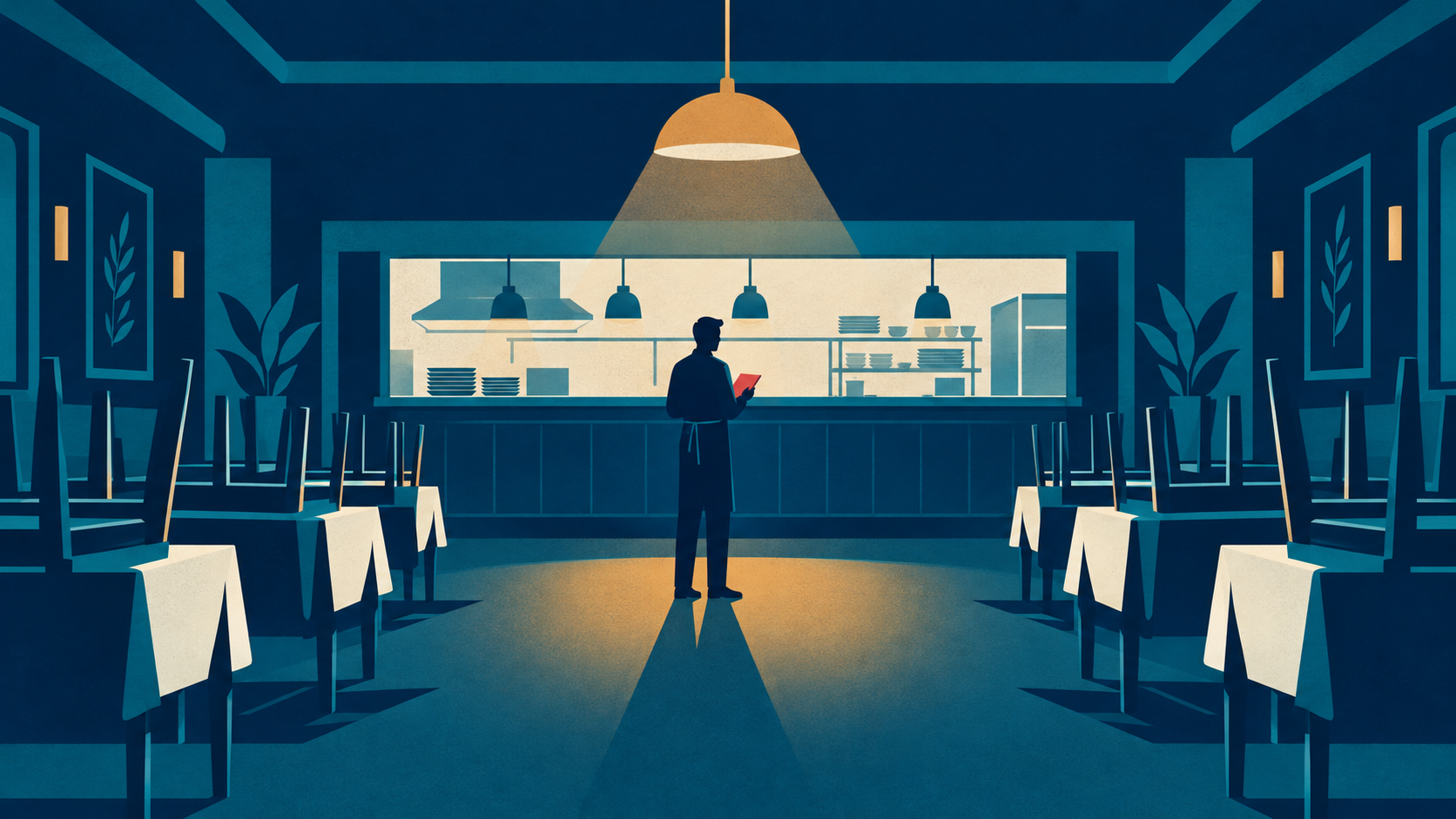
Read the beats in order. The stop worked. By the author’s own telling, the printer quieted, the rail cleared, and the cooks got room to work — “this brief, beautiful eye of the storm.” Then came the restart: seating resumed at full speed into the lobby that had been allowed to build, double-seating some servers, triple-seating others, seating Guests who had “already exhausted their patience.” Twenty minutes later the kitchen was back in the weeds, and the essay draws its verdict: stopping seating doesn’t work.
But the crash was not the stop failing. The stop did its job; the restart undid it — a restart run without any of the pacing the essay itself spends three thousand words advocating. The proof offered against the lever is, by the author’s own account, a botched recovery executed by the person making the argument. That is the hardest evidence available in this debate, and it points the other way.
Demand Is Not Inventory
The essay’s best line contains its one wrong word: “We weren’t eliminating demand. We were accumulating it.” Demand is not a thing you can accumulate. A cover is not a widget in a queue — it is a person re-making the decision to wait every minute they stand there, and it evaporates the moment they decide otherwise. You cannot bank a Guest. The lobby is not a holding pen, and nothing standing in it belongs to you.
The moment an operator treats waiting Guests as stored demand, the operator has already decided to spend them — to run their patience down as a resource and restart into whatever is left of it. The move is the opposite: release the demand honestly at the door and let it sort itself. Some stay, some go, and the ones who stay chose the deal. That is a calmer restart, and it costs nothing.
The Door Is A Filter. The Table Is A Commitment.
This is the distinction the whole debate keeps missing, and it is the reason the same argument happens in every restaurant that has it. Losing a Guest at the door costs a cover. Losing a Guest at the table costs the Guest.
At the door, the Guest still holds everything: their time, their options, their evening. Given full information, they make their own decision — and if they walk, the visit was never yours to lose. At the table, the Guest has committed. They gave you their evening on the strength of a promise, and when the promise breaks — the forty-minute ticket, the food that dies in the window, the apology tour — they do not file it as a busy night. They file it as a place that took their evening and returned a bad one. A turned-away Guest can come back Saturday. A failed-at-the-table Guest tells ten people.
That is why the seating decision is not a lever to be argued over mid-shift. It is a promise being made or withheld, and the only question worth asking is whether the operation behind the promise can hold it.
The Honest Door: Reason, Out, Real Number
When the kitchen is at its limit, the protocol is three parts, and all three are required.
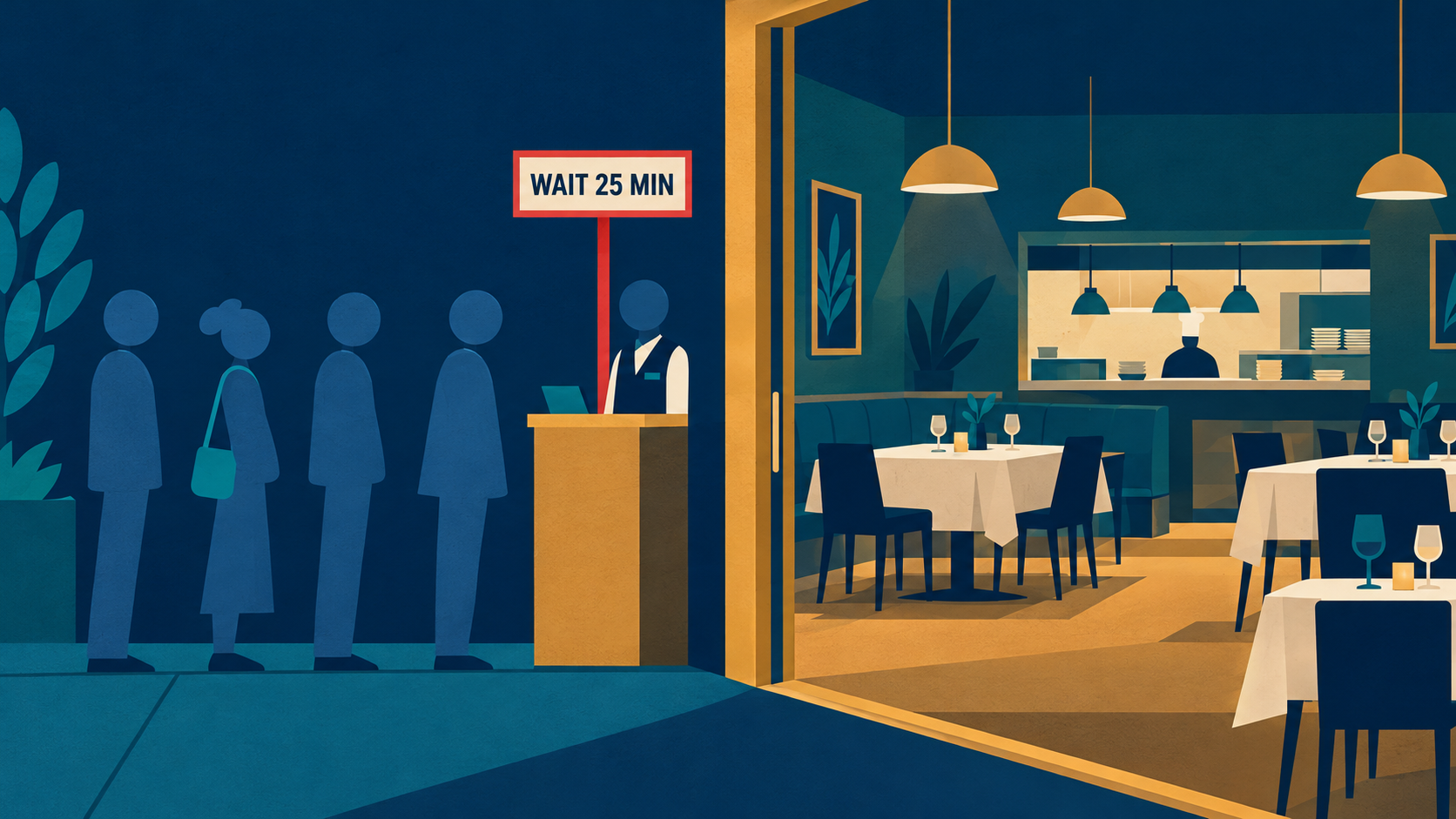
Tell them why — “the kitchen is at its absolute limit right now” — because the reason is what makes the no an invitation instead of a door in the face. Give them the out — “if you have other plans, this is the moment to consider them” — because the out keeps the decision theirs instead of yours. And give them a real number — and hold it. The number is a contract. A stated wait you blow is worse than no stated wait at all: you made a promise at the door and broke it at the table, which loses the Guest in both places at once.
The gestures are not the protocol. The drink sent to the lobby, the cider on a cold day — those are goodwill purchased to keep the contract affordable. They matter, and they work only on top of the three parts, never instead of them.
The No With A Reason Is An Invitation
Tell a Guest you’re full because of capacity and they want to know why — they want to come back and experience that for themselves. Tell them no for no good reason and they walk. Same word, opposite outcomes. Capacity honestly delivered is marketing: the full book is the loudest proof of demand a restaurant can produce, and it costs nothing but the truth.
And the demand does not die when a restaurant is hard to get into — it reshapes. Guests book further out, come on Mondays, take the bar, arrive at 4:45. The full book trains the pattern, not the exit. The Guests who walk at an honest no were renting the convenient slot — the eating decision, not the dining one, [Eating and Dining] in one line — and they were always going to go wherever Tuesday is easy. They were never your Guests; they were your convenience’s.
The only thing that actually trains a Guest to leave is the bad no: the dishonest wait, the forty-five minutes that becomes ninety, the turn-away with no reason and no alternative. Capacity honestly delivered is marketing. Capacity arbitrarily denied is the only reliable way to lose a Guest you never had to.
If The Crash Recurs, It’s The Cast
The honest door is the emergency mechanism. It exists for the rare, real crash — the short-staffed night, the equipment failure, the genuinely unforeseeable. The same crash on the same shift more than once is not a door question. It is either staffing built for the average instead of a peak you could already see coming, which is a scheduling failure, or a kitchen manager who cannot hold the pass, which is a capability failure. Both are personnel answers.
The same argument every weekend is not a disagreement — it is a hiring decision being postponed. The tell in the essay sits in plain view: the same brunch, the same argument, every weekend, with the fix on the table each time being which lever to pull mid-shift. Nobody escalates past the lever. The lever is the conversation; the cast is the problem.
Busy Kitchens Are Easier To Lead
The industry conversation keeps this backwards. A busy kitchen leads itself: the demand supplies the tempo, every station has purpose, the cast rides momentum, and the leader’s job is keeping time. The hard shift to lead is the slow Tuesday lunch — nothing urgent to organize around, and you find out in real time whether you built standards or just depended on the rush to enforce them. Idle kitchens are where discipline dies, not busy ones.
So when an operator describes a kitchen crumbling under volume, the volume is not the problem. Pressure is the easiest thing to lead. What is crumbling is a cast that was never built for the busy house, or a leader who cannot keep tempo once the shift is already carrying the team. The rush is your friend. It is the only shift that tells you the truth about what you built.
Architecture Never Designed To Hold The Volume
Under all of it sits the ground floor: the peak was always known. The brunch, the Saturday, the holiday — the demand curve is not a surprise. It is the single most predictable fact a restaurant owns. If the line, the stations, the staffing and the production system were not built to hold that curve, then the crash is not an event. It is the default being read aloud by the busiest shift of the week.
This is [By Design Or By Default] at kitchen scale: the architecture either holds the volume because it was designed to, or it discovers the volume because it wasn’t. You do not negotiate with architecture mid-shift. You build to the peak, or you keep having the same argument with the kitchen.
The seating decision, the pacing, the honest door — all of it is the management of a designed-or-defaulted system. The door protocol is how you run the default honestly. The architecture is how you stop needing to.
The Diagnostic
Run these against your own operation.
The Same-Saturday Test. Pull four Saturdays of ticket times. If the line breaks in the same hour every week, you do not have a seating problem — you have an architecture that was never designed to hold that hour.
The Door-Sentence Test. Stand at your own door at your fullest hour and listen to what your host says to a party you cannot seat. If the sentence does not contain a reason, an out, and a real number, the door is defaulting.
The Contract Test. Compare quoted waits to actual waits for one week. A wait you cannot hold is a promise you should not make.
The Station Test. When a cook says a pan is in the wrong place, what happens? If the answer is a complaint, the mechanism is missing. If the answer is that it moves, the cast owns the station. The distance between observed and implemented is authority, and authority is designable.
The Closer
The differentiation that decides the whole question is one sentence long. Tell a Guest you’re full due to capacity and they want to know why — they want to come back and experience that for themselves. Tell them no for no good reason and they walk. Capacity honestly delivered is marketing. Capacity arbitrarily denied is the only thing that trains a Guest to leave. Everything else — the pacing, the protocol, the architecture — is just how you keep the promise the full book makes.
What You Do Monday Morning
This Saturday, stand at your own door at your fullest hour and write down, word for word, what your host says to a party you cannot seat. If the sentence doesn’t carry a reason, an out, and a real number, write the sentence that does, and hand it to the host before the next shift. Then pull your last four Saturdays of ticket times and find the hour the line breaks. That hour is not a staffing note. It is the architecture telling you what it was never built to hold — and it will keep telling you, every Saturday, until you answer it.
Digging Deeper
Positions on the record:
The Restaurant That Never Needed Forgiving — jeffreysummers.com [confirm URL against the live post before publish]
I Canceled My Own Dinner. It Proved Everything I Wrote This Week — The Restaurant CEO
Congratulations, You Just Killed Your Culture! — The Restaurant CEO
Terms used in this piece: By Design Or By Default, Eating and Dining. Definitions in the Knowledge Base: https://kb.jeffreysummers.com/
Sources Cited In This Piece
Nathaniel Allen, “Chef, I’m Not Stopping Seating,” LinkedIn, October 29, 2026 — the brunch story; the stop that cleared the rail; the restart at full speed with double- and triple-seating; Guests “who had already exhausted their patience”; the twenty-minute re-crash; “We weren’t eliminating demand. We were accumulating it.”; “this brief, beautiful eye of the storm” — https://www.linkedin.com/in/nallenprofile/ (author’s profile; swap in the direct article URL when available)
Discover more from Jeffrey Summers
Subscribe to get the latest posts sent to your email.