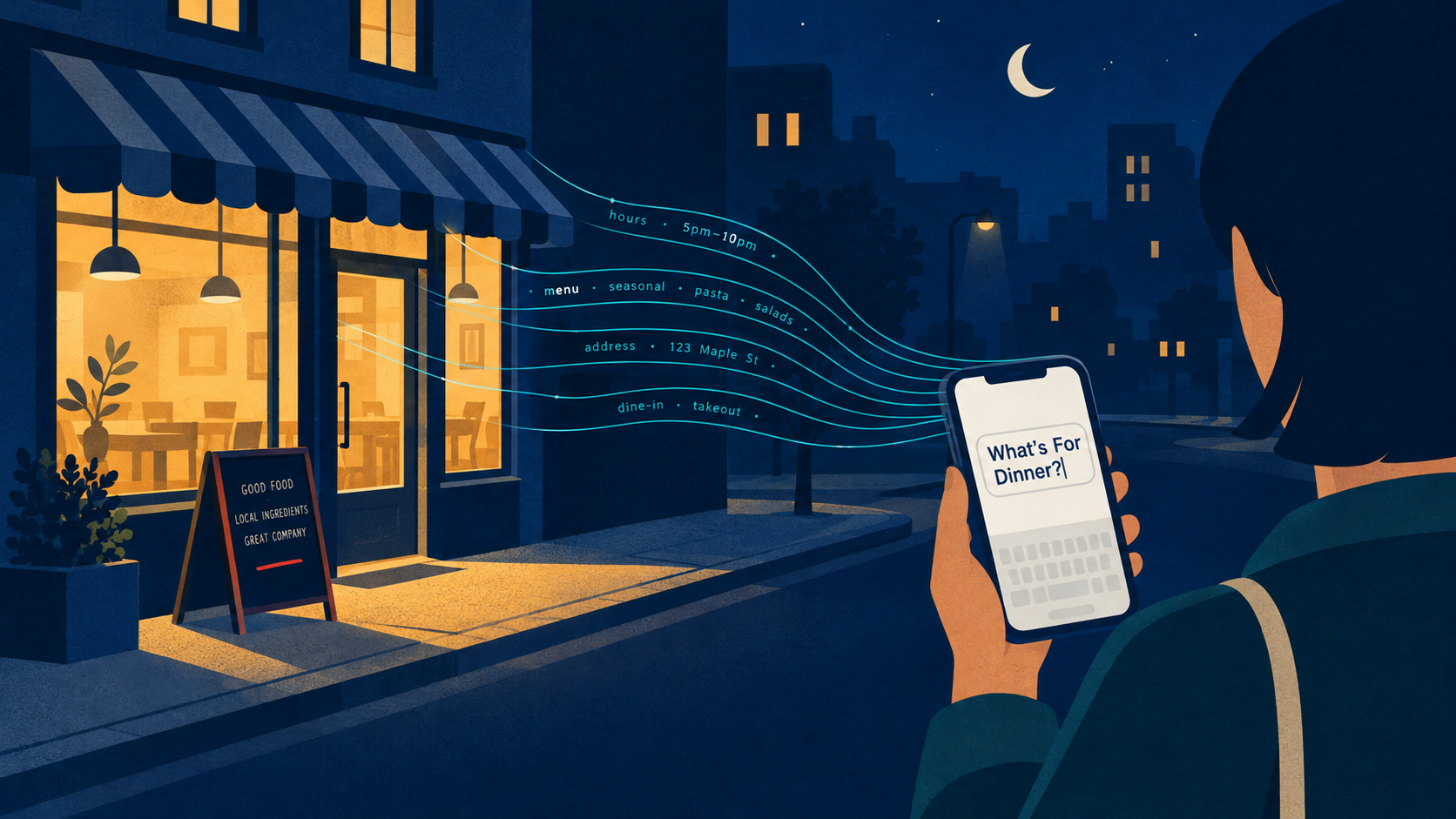

The next Guest who finds your restaurant will not search for it. They will ask a machine, and the machine can only recommend what it can read.
That is the whole shift in one sentence. The Guest’s question has not changed — what’s for dinner? — but the place it gets answered has. Discovery is moving from the search box to the assistant, and the assistant does not browse, sample, or explore. It reads what has been published about you, cross-checks it, and answers. The operator whose restaurant is readable becomes the recommendation. The operator whose restaurant is a PDF menu, a stale Google profile, and three different phone numbers across four listings becomes invisible in a channel he cannot see — and cannot buy his way back into. What is at stake is the visit, and this time the intermediary standing between you and it is not a delivery app. It is the answer itself.
How The Machine Reads
The machine does not browse. It does not sample, explore, or get charmed by a good photograph. It reads — and it reads exactly four things: structure, consistency, currency, and text.
Structure is schema markup, the labeled data on your website that tells the machine: this is the name, this is the address, these are the hours, this is the menu, this is where reservations happen. It is the machine’s native language, and almost no independent restaurant speaks it. It is a one-time setup most web people can do in an afternoon, and it is the difference between the machine understanding your restaurant and the machine guessing about it.
Consistency is one identity everywhere. The same name, the same address, the same phone on Google, on Yelp, on OpenTable, on the delivery apps, on your own site. The machine cross-checks listings against each other before it answers, because contradiction is how it detects unreliability. Three phone numbers across four listings does not read as a restaurant with several numbers. It reads as a restaurant that cannot keep its own records.
Currency is hours that are true tonight — holiday hours included. The machine does not check whether the door is actually unlocked. It reads what was published, states it with full confidence, and sends the Guest. Stale hours do not read as stale to the Guest. They read as a locked door and a broken promise, and the machine made it.
Text is text. A PDF menu is a picture of a menu. An image of your address is a picture of your address. The machine cannot read pictures. It reads the words on the page: the menu as actual text, the hours in plain HTML, the answers to the questions Guests actually ask — parking, groups, kids, dietary. If it exists only as an image, it does not exist.
The Precedent Is Already On Your Phone
The industry has run this play before, and recently.
Third-party delivery arrived as convenience. The Guests adopted it first, the operators followed, and within a few years the apps owned the Guest data, the ordering behavior, and the terms. The operators who built their own doors late paid for the privilege.
It happened again in October 2026, when Olo — the company operators pay to build their own ordering — opened a door of its own, the Olo App, stocked it with the brands that pay it, and kept the Guest’s account on its side of the door. The operator who built his direct door on Olo’s stack now competes with his own vendor for his own Guest.
The AI discovery layer is the same play, one layer up. The assistant that answers what’s for dinner? is a door. Whoever’s data it reads becomes the answer, and whoever’s account the Guest books through owns the relationship. That is the [Operator-Owned Direct Channel] argument carried forward: the machine layer should read your door, not replace it.
The vendors see the layer forming before the operators do. OpenTable is already marketing AI booking to its operator list — 44% of Americans planning to use AI more to book reservations in 2026, 36% of operators planning to adopt. Treat those figures as vendor marketing, not evidence. But read the spending: the intermediaries are buying position in a layer the operators have not entered yet. That gap — Guests first, operators paying rent after — is the recurring pattern of this industry. Online ordering ran it. Delivery ran it. Reviews ran it. The machine is running it again.
The Design
None of this requires an agency, a retainer, or a new platform. It requires operating discipline — the same discipline you already run on inventory. Six moves.
Your website is the source of truth. It is the one asset you own, and every other listing points at it, never replaces it. Menu, hours, address, phone, reservation link — in plain text, on your own pages.
Structured data on the site. Restaurant schema markup: name, address, hours, menu, price range, reservations URL. One afternoon, once.
One identity, everywhere, identical. Same name, same address, same phone on every listing. The machine cross-checks, and contradiction reads as unreliability.
The Google Business Profile complete and current. It is the single biggest input the machine reads about a local restaurant. Hours updated — including holiday hours — because stale hours means the machine confidently sends a Guest to a locked door.
Reviews as a living corpus. The machine reads the review history, not the rating. Steady fresh reviews and responses signal a restaurant that is alive. A five-star rating from eighteen months ago reads as a restaurant that might not be.
Answer the questions Guests ask an assistant. Parking, groups, kids, dietary, noise — on the site, in plain question-and-answer form. The FAQ page is now written for the machine, and for the Guest who never calls to ask.
The Diagnostic
Four tests, each with a yes or no read.
The machine test. Ask an AI assistant about your own restaurant the way a Guest would: where to eat tonight, near you, your cuisine. Read the answer against what is true. Every wrong fact in that answer is a fact you published wrong somewhere, or failed to publish at all.
The text test. Open your own website and try to select the menu with your cursor. If you cannot — if the menu is an image or a PDF — the machine cannot read it either. It reads nothing.
The identity test. Pull up your restaurant on Google, then Yelp, then OpenTable. Three listings, one name, one address, one phone. Any variance is illegibility, and the machine is downgrading you for it right now.
The currency test. Look up your own holiday hours. If they are last year’s, the machine will send a Guest to a locked door on the busiest night of the quarter — and state it with full confidence.
The score sorts itself. Zero wrong facts means the machine is reading you. One wrong fact means you have a publishing problem. A page of wrong facts means you are invisible in the channel and do not know it.
The machine will answer the question — that part is already decided. Legibility decides whether the answer is you. And the read is the same read this industry keeps refusing to learn: the Guests move first, the intermediaries buy the layer, and the operators pay rent to catch up. This is the one where catching up is cheap. The operators who get read are the ones who already run their information like they run their inventory — published, current, owned. The Guest is asking the machine what’s for dinner. Make yourself legible to the machine, or pay rent to whoever is.
The Monday Morning Move
Ask the machine about your own restaurant.
Open an AI assistant — the one on your phone is fine — and ask it the Guest’s question: what’s for dinner tonight, near me? Read the answer. Every wrong fact in it — the hours, the address, the menu item that has not existed since spring, the phone number from two owners ago — is a fact you published wrong somewhere or failed to publish at all. The first wrong thing it says is the first thing you fix, and the place you fix it first is your Google Business Profile, because that is the single biggest input the machine reads about you.
One move. One asset. One test. The move is the question, the asset is the profile, the test is the answer read against what is true.
If you like this move, you should subscribe to The Monday Morning Move — one move, one asset, one test, every Monday:
Digging Deeper
Positions on the record:
I Sent My Clients To Olo To Build Their Own Door: Now Olo Runs A Door That Competes With It
Your Door Is The Only One That Keeps The Guest
Terms used in this piece: Operator-Owned Direct Channel. Definitions in the Knowledge Base.
Sources Cited In This Piece
OpenTable, November 2026 — 44% of Americans plan to use AI more to book reservations in 2026; 36% of operators plan to adopt — vendor marketing email to its operator list.
Olo App, October 2026 — the vendor opened its own consumer door stocked with paying brands, with the Guest account held
Discover more from Jeffrey Summers
Subscribe to get the latest posts sent to your email.