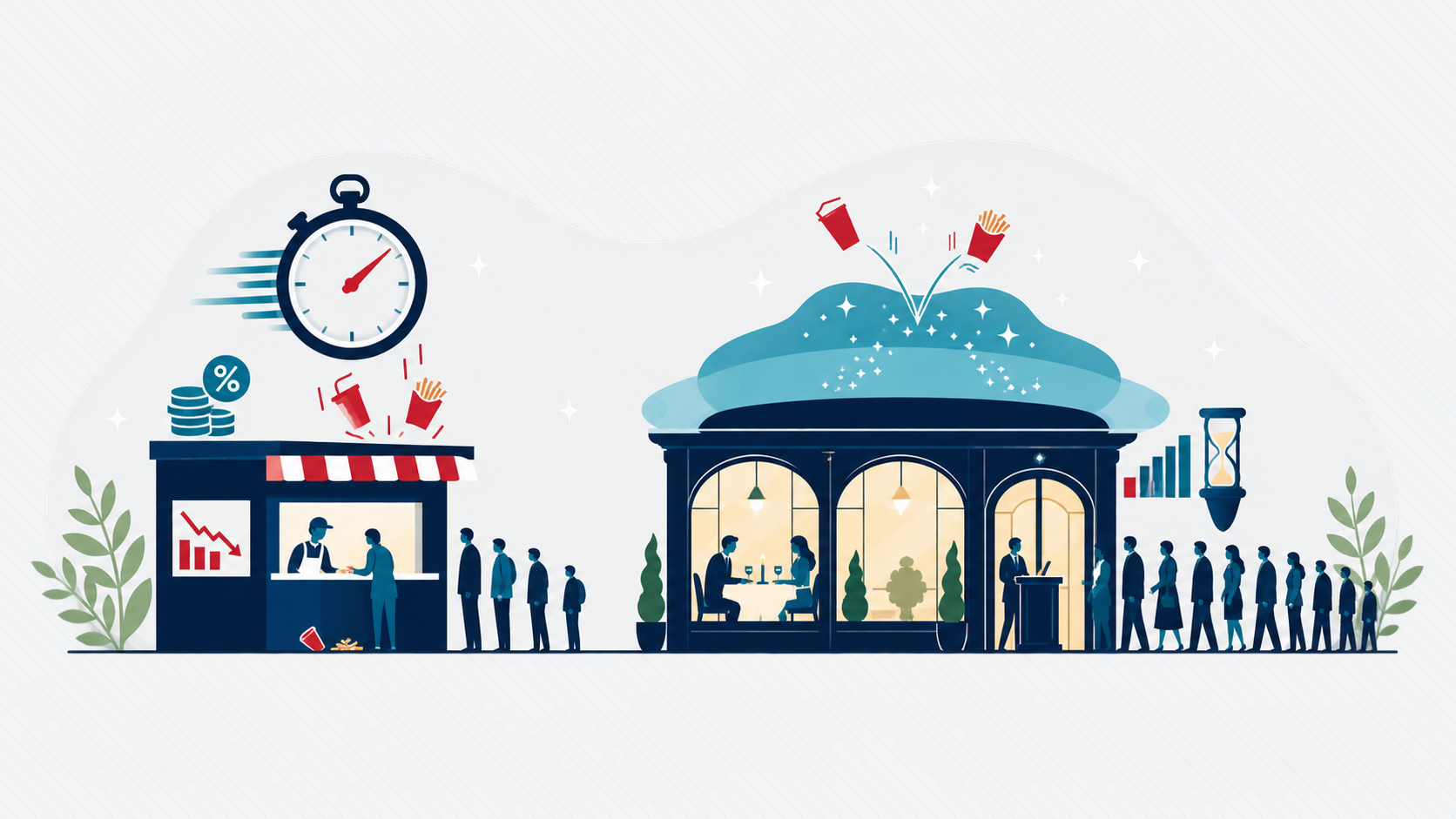

The two Guests are the oldest distinction in the business. The refusal to choose between them is being narrated as change.
That line crossed my feed this week. It came from a panel of restaurant-industry leaders — operators whose brands you know — assembled to talk about where to allocate budget, which skills to grow, and what’s changed in the last 24 months.
The sentence deserves an answer, because it’s doing something. And what it’s doing is more interesting than what it says.
THE TWO GUESTS ARE REAL
The post describes two Guests, and describes them well. One wants a solid greeting, his name known, clean bathrooms, a little small talk, engagement. The other wants hot food waiting when he walks in, no conversation, and to be gone before anyone notices the food is missing.
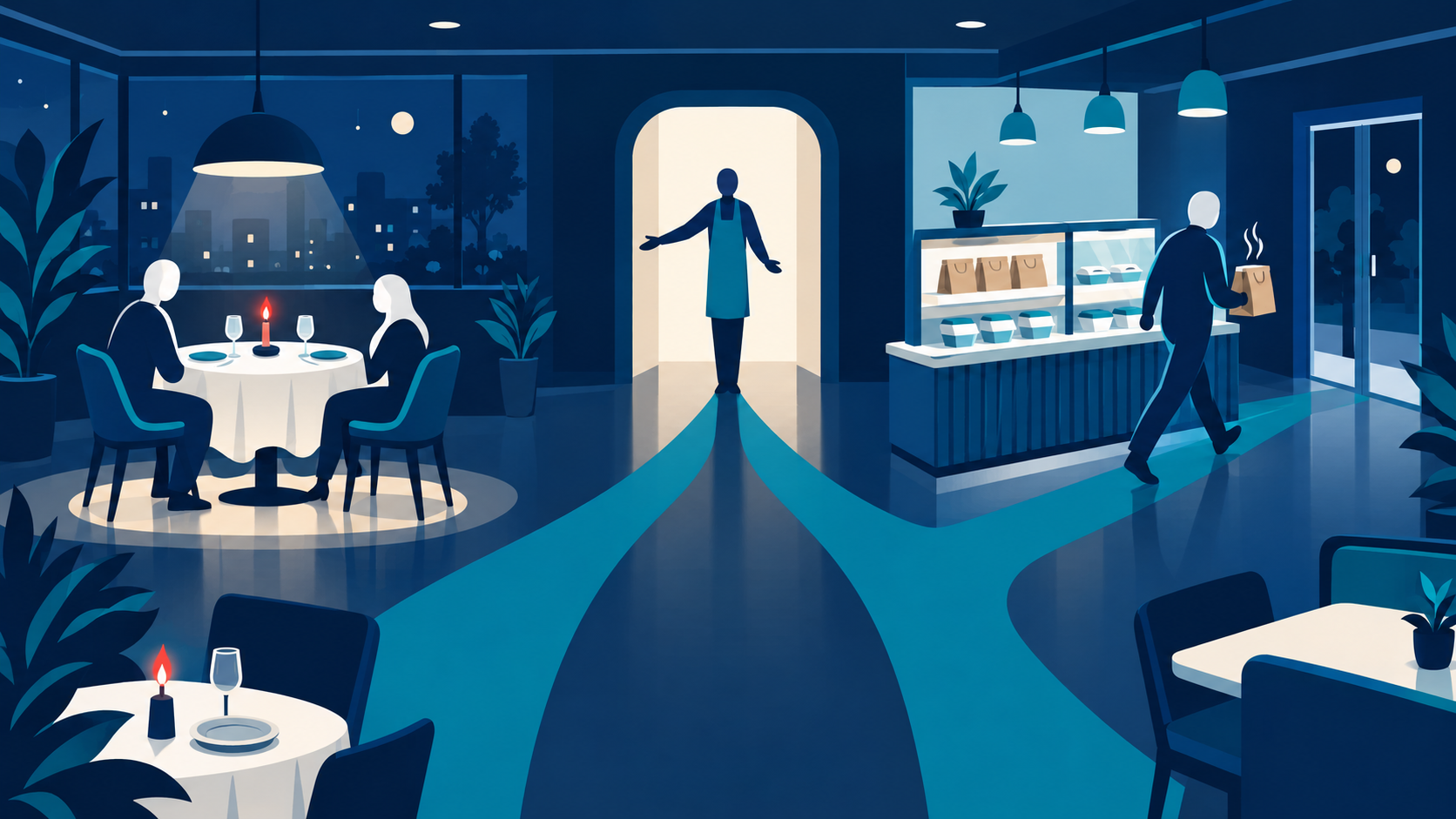
Both Guests are real. Both have always been real. One is buying dinner. The other is buying food. Eating versus dining is the oldest distinction in this business — older than every technology in the stack, older than every channel, older than the panels assembled to discuss it. Some people come to eat. Some people come to dine. That was true before restaurants had names.
NOTHING IS FRAGMENTING
So what evolved? What fragmented?
Not the Guest. The distinction is anthropological, not technological. It sits in what a person wants from an occasion, and occasions are as old as the species. No panel has ever changed what someone wants from a Tuesday night.
What changed is the operation. The operator who tries to run both roads through one building and one cast experiences his own indecision as the world changing. Serve the Guest who wants to dine with a cast built for speed, and the operation feels strained. Serve the Guest who wants speed with a cast built for engagement, and the operation feels slow. Run both at once and the operation feels — fragmented.
The Guest didn’t fragment. The refusal to choose did.
WHY NARRATE PERMANENCE AS CHANGE
There’s a reason this narration is everywhere, and it’s worth saying plainly.
A reality that evolves and fragments requires tools sophisticated enough to track each fragment. A permanent distinction requires only a decision. Fluidity is a sales channel. Settled questions don’t generate recurring revenue.
The narration also flatters the operator. “What’s changed in the last 24 months” tells everyone in the room that nothing is his fault — the Guest changed, the business evolved, reality fragmented. If the distinction were permanent, then failing to serve both Guests is a choice he’s been avoiding for years. Narrate it as change, and the operator is outdated instead of undecided. Outdated has a cure you can buy. Undecided has a decision you have to make.
THE CHALLENGE ISN’T THE CHALLENGE
The post calls this “a challenging job for hiring staff, training expectations, and teaching operating procedures and systems.”
It’s only a challenge if one operating model has to serve a spectrum. It isn’t a spectrum. It’s a choice.
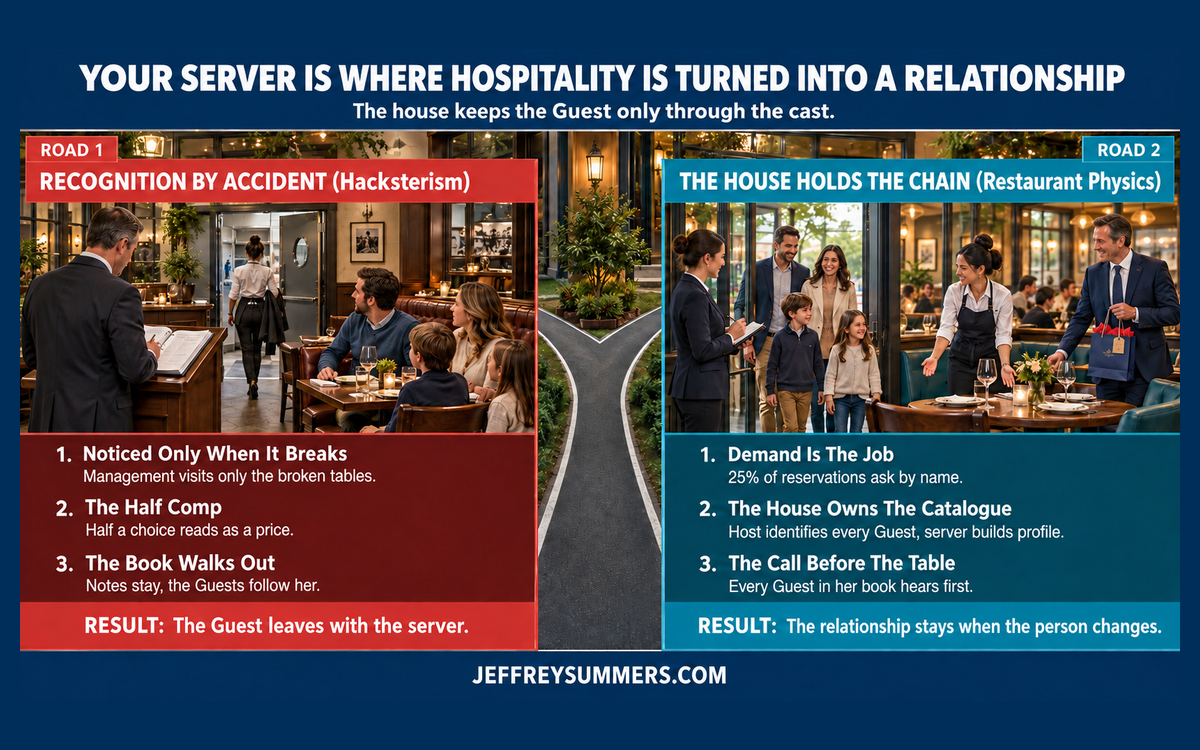
Pick the road, and the road dictates the cast, the training, the procedures, the budget. Every challenge the panel listed dissolves into one decision. The transactional road designs for speed, accuracy and hot food waiting; its cast is built to execute. The relational road designs for being known, engaged and remembered; its cast is built to produce hospitality. Two products. Two designs. One decision that decides both.
Refuse to pick, and every one of those challenges is permanent. That’s the business the fragmentation narrative is in: it renews the problem quarterly so it can never be solved once.
A SHALLOW READ EXPERIENCES PERMANENCE AS CHANGE
There’s a deeper mechanism under the narration, and it’s the one worth taking.
At the surface, everything does look like flux — new channels, new tools, new expectations quarter by quarter. The fragmentation narrative is what the business feels like from inside a survey. A survey can only report fragments, because a survey has no commitment to go deep on anything.
The foundational read finds the permanent structure underneath the flux. Some people dine. Some people eat. Once you’re standing on structure, the evolving reality reveals itself as one decision that was never made, followed by a design that was never deepened.
DECIDE, THEN READ, THEN DESIGN
The full answer to the panel’s question is three moves, in order.
The decision is once. Choose the Guest this business is for. The road settles what counts as fundamental — before the decision, a read of both roads is just a survey.
The read is continuous, and it deepens. The distinction itself never gets re-read — it’s settled. What gets read, increasingly foundationally, is the application: this operation, this market, this period, this cast. Each pass starts at an innovated position and digs toward the fundamentals underneath it.
The design is what the read feeds. The creative process applies to what the read surfaces — the architecture of the business redrawn each pass against what the fundamentals now show.
That’s the whole work. Decide once. Read forever, deeper each pass. Design from what the read surfaces.
THE TECHNOLOGY QUOTE
The best line in the post was “Restaurants don’t need more technology solutions.” Correct, and incomplete. Restaurants don’t need more solutions at all. They need a decision. The technology would follow the decision; it cannot replace it. A tool serves a design. It can’t tell you what to build, and the operator who hasn’t decided doesn’t need a tool. He needs to decide.
THE RULE
The Guest didn’t fragment. The refusal to choose did. One decision, then a lifetime of reading deeper — that’s the whole game. Everything else is narration.
—————————————————
DIGGING DEEPER
Positions on the record:
The Restaurant That Never Needed Forgiving — https://jeffreysummers.com/the-restaurant-that-never-needed-forgiving/
The Guest Touchpoint Map — https://kb.jeffreysummers.com/docs/guest-touchpoint-map/
Growth Is Capability You Own, Not Sales You Buy — https://physics.jeffreysummers.com/growth-is-capability-you-own-not-sales-you-buy-a-starbucks-example/
Your Door Is The Only One That Keeps The Guest — https://physics.jeffreysummers.com/your-door-is-the-only-one-that-keeps-the-guest-the-olo-app-doordash-and-uber-eats-want-him-on-theirs/
Terms used in this piece: [Eating-Dining Distinction], [Two Roads], GX. Definitions in the Knowledge Base: https://kb.jeffreysummers.com/
SOURCES CITED
Anthony Presley, LinkedIn post, October 27, 2026 — restaurant-industry panel on Customer Success and Customer Service; the two-Guest description (greeting, name known, clean bathrooms, small talk and engagement versus hot and ready food, no conversation, gone before anyone notices); “Customer Success in restaurants continues to evolve and fragment”; “Restaurants don’t need more technology solutions” — https://www.linkedin.com/in/apresley/
Discover more from Jeffrey Summers
Subscribe to get the latest posts sent to your email.